Looming West Coast Fuel Crisis

California Refinery Closures Spark Supply & Price Fears in Neighboring States
California's regulatory posture has been aimed at moving the state away from fossil fuels. It appears that this goal is now becoming a reality with the closure of major refineries within the state. These closures are now sending shock waves through neighboring states that were dependent upon California refineries, threatening higher gas prices and supply disruptions. With Nevada, Arizona, Oregon, and Washington heavily reliant on California's refining capacity, experts warn of volatility ahead, even as national gas prices trend downward. Adding to the uncertainty? Potential tariffs on Canadian crude oil under President Trump's administration as a response to Canada's declaration of a trade deal with China. This could further strain Washington's refineries, which process significant imports from north of the border.

California's aggressive environmental policies, including zero-emission vehicle mandates by 2035, and the curtailment of much of the state's crude oil production, have prompted refinery operators in the state to scale back operations or shut down. The state's isolated West Coast market—part of the Petroleum Administration for Defense District 5 (PADD 5)—lacks robust pipeline connections to other U.S. refining hubs, making it vulnerable to local supply cuts. Recent closures have already reduced capacity by 17-20%, forcing greater reliance on Washington state refineries and on costly imports while exacerbating price swings.
Latest on Refinery Closures
Phillips 66 completed the shutdown of its Wilmington refinery near Los Angeles in late 2025, removing about 139,000-147,000 barrels per day (bpd) of capacity amid regulatory pressures and declining demand. Valero's Benicia refinery in the Bay Area, with 145,000 bpd, is on a phased wind-down. Processing units will idle by April 2026, but the company announced on January 6, 2026, that it will continue importing and distributing gasoline to mitigate shortages. This update, praised by Governor Gavin Newsom, aims to soften the blow of losing 2.2 billion gallons of annual gasoline supply. However, hundreds of layoffs are underway, and critics argue the moves highlight the economic fallout from state policies.
These developments build on earlier warnings. Combined, the closures could eliminate nearly 300,000 bpd, prompting fears of $8+ per gallon spikes in extreme scenarios, particularly during peak summer demand. Also, the refining of imported oil will result in higher local fuel costs.
Impacts on Neighboring States
States dependent on California for fuel—Nevada (90% reliance), Arizona (33%), and parts of Oregon and Washington—are bracing for ripple effects. The interconnected PADD 5 market means shortages in California could cascade, leading to higher imports, volatility, and elevated prices relative to national averages.
Nevada and Arizona: With heavy dependence, these states could see prices $1+ above the U.S. average. GasBuddy forecasts Arizona at $3.09-$3.38 for 2026; Nevada similar, with risks of shortages in areas like Reno.
Oregon: Prices started 2026 at $3.42/gallon, dipping to near five-year lows, but closures could trigger summer spikes.
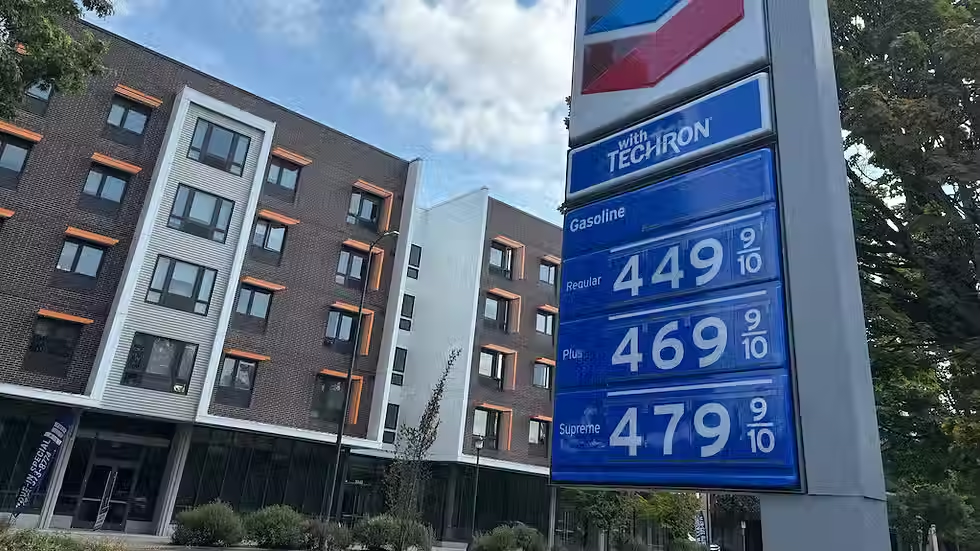
Washington: Averages around $4.53 early in 2026, with in-state refineries providing a buffer but still vulnerable to regional shocks, including past pipeline outages.
Mitigation Efforts: New Pipelines on the Horizon
To counter dependency, Nevada is expanding natural gas infrastructure via Great Basin Gas Transmission, targeting completion by 2028. More crucially, Phillips 66 and Kinder Morgan launched a second open season for the Western Gateway Pipeline on January 16, 2026, seeking commitments for remaining capacity. The project, slated for 2029, will transport Midwest refined products to the Southwest and now potentially Los Angeles, using new builds and reversals to alleviate shortages. Oregon and Washington are focusing on local enhancements and imports.
Emerging Threat: Tariffs on Canadian Crude
Compounding risks, President Trump's proposed tariffs on Canadian imports—potentially 10-25%—could disrupt Washington's refineries, which source 40-50% of feed-stock from Canada via pipelines like Trans Mountain. Trump has threatened even higher tariffs if Canada proceeds with its trade deal with China. Tariffs in the 10-25% range are estimated to reduce output by 5-20% short-term, spiking regional prices $0.50-$1.00/gallon and threatening jobs in an industry employing ~2,000 in the state. While Canadian producers may absorb some hits, U.S. refineries optimized for heavy Canadian crude face diversification challenges. If the tariffs go beyond that, supply to Washington refineries could be greatly curtailed. Ironically, Washington refineries are suited to the Venezuelan crude that will now be coming to the U.S. but Venezuela is a long way from Washington. Most of that oil will be headed to Texas refineries.
Outlook: Volatility Ahead, But Relief Possible
Short-term, expect elevated West Coast prices and potential shortages through mid-2026, tempered by global crude declines. Longer-term, pipelines like Western Gateway offer some hope but it may not be fully operational until 2029.
Sources:
Key Sources for the West Coast Fuel Crisis Article
Below is a concise list of primary sources referenced or informing the article's content, drawn from recent reports, government statements, and industry updates as of January 2026. I've prioritized those directly related to refinery closures, price forecasts, pipeline projects, and trade impacts, including links for further reading.
Governor Newsom's Statement on Valero's Benicia Refinery Update - California Governor's Office (Jan 6, 2026) https://www.gov.ca.gov/2026/01/06/governor-newsoms-statement-on-valeros-benicia-refinery-update Details Valero's plan to continue gasoline supply post-April 2026 idling.
Oil Giant to Continue Supplying Fuel After Planned Shutdown of Bay Area Refinery - SFGATE (Jan 7, 2026) https://www.sfgate.com/bayarea/article/oil-giant-supply-fuel-bay-area-refinery-21282305.php Covers Valero's Benicia shutdown and import strategy.
Refinery Closures Present Risk for Higher Gasoline Prices on the West Coast - U.S. EIA (Jul 9, 2025) https://www.eia.gov/todayinenergy/detail.php?id=65704 Analyzes impacts of Valero Benicia and Phillips 66 closures on regional prices.
Valero Plans Gasoline Imports as California Refineries Close - Industrial Info Resources (Jan 9, 2026) https://www.industrialinfo.com/news/article/valero-plans-gasoline-imports-as-california-refineries-close--351603 Discusses Valero's April 2026 Benicia closure and supply shifts.
California Refinery Closures Set Up a Downstream Stress Test - JobbersWorld (Nov 14, 2025) https://jobbersworld.com/2025/11/14/california-refinery-closures-poise-a-downstream-stress-test-for-jobbers Examines combined effects of Phillips 66 and Valero closures.
Phillips 66 and Kinder Morgan Announce Launch of Subsequent Open Season for Western Gateway Pipeline - Kinder Morgan IR (Jan 16, 2026) https://ir.kindermorgan.com/news/news-details/2026/Phillips-66-and-Kinder-Morgan-Inc--Announce-Launch-of-Subsequent-Open-Season-for-Remaining-Western-Gateway-Capacity-and-Expanded-Origins-and-Destinations-2026-Er19ACEHqG/default.aspx Latest update on the pipeline's second open season.
Western Gateway Pipeline Official Site - Phillips 66/Kinder Morgan https://westerngatewaypipeline.com/ Overview of the project connecting Midwest to Southwest fuels.
EIA Expects Lower Gasoline Prices in 2026 and 2027 - U.S. EIA (Jan 2026 STEO) https://www.eia.gov/todayinenergy/detail.php?id=67024 National and West Coast gas price forecasts, noting refinery risks.
Short-Term Energy Outlook - U.S. EIA (Jan 2026) https://www.eia.gov/outlooks/steo Projects $2.92/gallon national average, with West Coast elevations.
Yearly Average Gas Prices to Fall Below $3 in 2026 - GasBuddy (Jan 6, 2026) https://www.gasbuddy.com/go/2026-fuel-price-outlook State-specific outlooks for Arizona, Nevada, etc., at $2.97 national average.
Outlook Predicts Average National Gas Price to Fall Below $3/Gallon - AZ Family (Jan 6, 2026) https://www.azfamily.com/2026/01/06/outlook-predicts-average-national-gas-price-fall-below-3gallon-first-time-since-2020 GasBuddy forecast for Arizona ($3.09-$3.38/gallon).
Trump's Tariffs Would Hurt Canadian Oil Producers More Than U.S. Refiners - RBN Energy (Jan 30, 2025) https://rbnenergy.com/daily-posts/blog/trumps-tariffs-would-hurt-canadian-oil-producers-more-us-refiners Analysis of impacts on Washington refineries reliant on Canadian crude.
Trade Zone: Washington's Heavy-Oil Dilemma - RBC (Dec 5, 2025) https://www.rbc.com/en/thought-leadership/the-trade-zone/washingtons-heavy-oil-dilemma Discusses irreplaceable Canadian barrels for Puget Sound refineries.
Great Basin Gas Transmission Company Announces Close of Second Supplemental Open Season - Southwest Gas Holdings (Dec 8, 2025) https://www.swgasholdings.com/news-releases/news-release-details/great-basin-gas-transmission-company-announces-close-second Details Northern Nevada natural gas expansion.
Great Basin Secures 800 MMcf/d in Commitments for $1.7B Expansion - Natural Gas Intel (Dec 22, 2025) https://naturalgasintel.com/news/great-basin-secures-800-mmcfd-in-commitments-for-17b-northern-nevada-natural-gas-expansion Update on capacity additions by 2028.