
Why Raising Taxes on the Wealthy Is No Fix for Runaway State Spending

High-tax states keep bleeding billions in taxable income as wealthy residents and businesses vote with their feet. The latest IRS data confirms it: raising taxes is not the answer to a spending problem—it accelerates the problem.

Lines of U-Haul trucks leaving high-tax states for low-tax havens have become a symbol of the modern tax migration.
America’s states face chronic budget shortfalls from ballooning pensions, entitlements, infrastructure promises, and post-pandemic spending. Politicians’ go-to fix? Target the rich with new wealth taxes on net worth, steep “millionaire” income surtaxes, capital-gains levies, or revived intangible property taxes.
The historical and modern record shows these policies consistently backfire. High earners, businesses, and their taxable income flee to low- or no-income-tax states like Florida, Texas, North Carolina, and Tennessee. Tax bases shrink, revenue falls short of projections, and the burden shifts to everyone else.
Historical Lesson: Old-School “Wealth Taxes” Collapsed and Were Repealed
Long before today’s billionaire-tax proposals, states imposed broad intangible personal property taxes on stocks, bonds, mutual funds, and financial assets—de facto annual wealth taxes. By 1965, 14 states still enforced them (Florida, Georgia, Indiana, Kansas, Kentucky, Michigan, Missouri, Nebraska, North Carolina, Ohio, Oklahoma, Pennsylvania, Rhode Island, Virginia). Every one of them eventually repealed or sharply limited them due to evasion, administrative nightmares, negligible revenue, and capital flight.
Florida’s Intangible Tax Collapse (Clear Data Example) Designed to capture financial wealth, it peaked at nearly $1 billion annually (FY 1999–2000). By FY 2009–2010, after loopholes and avoidance, collections plummeted to just $174 million. Taxpayers used trusts and entity structures to make it effectively optional. The state repealed the annual tax in 2007, recognizing that it was driving investment and residents elsewhere.
Modern Tax Hikes Produce the Same Flight—With Even Bigger Numbers
Recent progressive income surtaxes, capital gains taxes, and proposed net-worth levies show the same pattern.
Latest IRS Data (2022–2023 Migration) – Billions in AGI Shifting to Low-Tax States
State | Net AGI* Change (2022–2023) | Key Notes |
Florida | +$20.6 billion | Largest gainer; no income tax |
Texas | +$5.5 billion | Strong inbound high earners |
California | –$11.9 billion | Largest loser |
New York | –$9.9 billion | Broad losses across brackets |
Illinois | –$6.0 billion | Heavy high-earner outflow |
Massachusetts | –$4.0 billion | 4th-highest net loss |
New Jersey | –$2.6 billion | Persistent decline |
Source: IRS Statistics of Income Migration Data (released March 2026). High-tax states dominate the losers; low-tax Sun Belt states dominate the winners. Some analyses put California’s loss as high as $13 billion. (*AGI=Adjusted Gross Income)
Table: Case Studies of Tax Hike Fallout
State & Policy | Intended Goal | Actual Adverse Impact |
Connecticut (1991 income tax + 2015 hike) | Fiscal stability | $653 million revenue shortfall post-hike; high earners left at ~$60/second AGI rate |
Maryland (2008 Millionaires’ Tax) | Close the budget gap | ~30% drop in millionaire filers; $1.7 billion total tax revenue loss from migration |
California (13.3% top rate + proposed wealth taxes) | Fund services | 24,670 high-earner households lost in one year ($16.1 billion AGI); ongoing $11.9B+ annual losses |
Washington (7% capital-gains tax 2022) | Target wealth | Reversed net income gains; high-profile exits (Bezos, etc.) |
The Undeniable National Pattern
IRS data year after year shows the same story: the highest-tax, most progressive states (California, New York, Illinois, New Jersey, Massachusetts, Connecticut) are the biggest losers of high-income residents and adjusted gross income. Low- or no-income-tax states are the biggest winners.
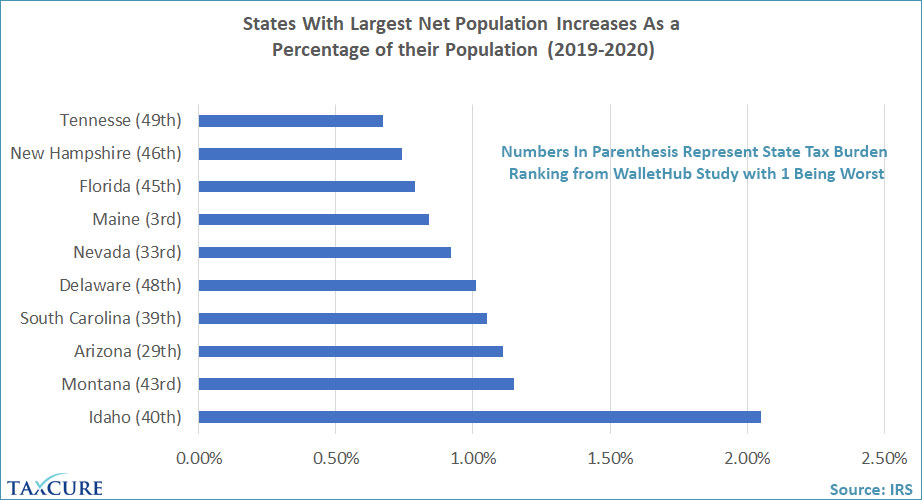

High earners move at higher rates than average. They take jobs, businesses, and future tax revenue with them.
Spending, Not Revenue, Is the Real Crisis
States do not have a revenue problem—they have a spending problem. When Connecticut, Maryland, California, New York, and others hiked taxes on high earners, they did not close gaps; they widened them by shrinking the pool of people willing (and able) to pay. Historical wealth-like taxes were repealed for the same reason. Modern proposals are producing preemptive flight even before passage.
The data is unambiguous: you cannot tax your way out of overspending when the people who foot the bill can—and do—leave.
The only sustainable path is the one politicians resist most: control spending, prioritize core services, and stop driving away the taxpayers who fund everything else. Until then, the tax-flight trap will keep snapping shut.
Sources:
IRS Official Data (Core AGI Migration Statistics 2022–2023)
IRS Statistics of Income – Migration Data 2022–2023 (official state-by-state AGI inflows/outflows) https://www.irs.gov/statistics/soi-tax-stats-migration-data-2022-2023
Recent Migration Summaries & Analysis
Wall Street Journal: “The High-Tax Wealth Flight Continues” (CA –$11.9B, NY –$9.9B, FL +$20.6B, etc.) https://www.wsj.com/opinion/states-taxes-migration-democrats-irs-f13d9d04
Realtor.com Analysis of IRS 2022–2023 Data (Florida +$20.6B, Texas +$5.5B, high-tax state losses) https://www.realtor.com/news/trends/net-income-irs-migration-data-2023/
Historical Wealth-Like Taxes
Florida Intangible Personal Property Tax: Revenue collapse (~$1B in FY 1999–2000 to $174M in FY 2009–2010) and repeal https://www.floridapolicy.org/posts/a-risky-proposition-weakening-local-governments-by-eliminating-property-tax-revenue
Official Florida DOR Repeal Notice (effective Jan. 1, 2007) https://floridarevenue.com/taxes/tips/documents/TIP_07C02-01.pdf
ITEP: History of State Intangible Property Taxes (14 states still taxing in 1965, all later repealed) https://itep.org/america-used-to-have-a-wealth-tax-the-forgotten-history-of-the-general-property-tax/
State-Specific Tax Hike Case Studies
Connecticut 2015 tax hike & AGI/revenue impact https://www.yankeeinstitute.org/2017/12/06/connecticut-lost-2-6-billion-in-2015-as-high-wealth-residents-moved-out/
Maryland 2008 “Millionaires’ Tax” (30% drop in filers, $1.7B estimated revenue loss) https://taxfoundation.org/blog/marylands-millionaires-missing-after-income-tax-hike/
Washington State Capital Gains Tax & Migration Reversal https://seattlered.com/taxes/rantz-washington-income-tax-exodus-migration-data/4117595
Additional Context
Center for Jobs (California high-earner exodus details) https://centerforjobs.org/ca/special-reports/high-earner-taxodus-continued-in-2022


