
The Homeschool and Private School Boom: Parents Are Voting With Their Feet as Public Schools Lose Ground

In Shasta County and across California, more parents than ever are choosing to homeschool their K-12 children or enroll them in private schools rather than send them to traditional public schools. The numbers tell a clear story: families are losing faith in the public system—and they’re acting on it.
According to the latest data from the National Home Education Research Institute (NHERI) and the Johns Hopkins University Homeschool Research Lab, 3.408 million American children were homeschooled during the 2024–2025 school year. That equals 6.26% of all school-age kids nationwide—more than double the pre-pandemic rate of roughly 3%. Private school enrollment, meanwhile, has held steady around 9–10% of total K-12 students (about 4.7 million kids) while showing continued post-COVID gains in many states, even as public enrollment has declined in numerous districts. That is about 9 million kids across the USA whose parents have lost confidence in the Public School system.
This isn’t a temporary blip. It’s a long-term trend that accelerated dramatically during the pandemic and has now resumed its upward climb.
From the Margins in the 1960s to Millions Today
Homeschooling was a niche practice in the 1960s and 1970s—estimates put the national total at just 10,000–15,000 children. Many states didn’t even legally recognize it until court battles and legislative changes in the 1980s and 1990s cleared the way. By 1999, the figure had grown to about 850,000 students (1.7% of school-age children). Steady growth followed, reaching roughly 2.5 million by 2019 (about 3%).
Then came COVID. School closures and remote learning exposed millions of parents to what was actually happening in classrooms. Homeschool numbers spiked to approximately 3.7 million (as high as 11% in some surveys) during the 2020–2021 peak. Many families returned to public schools once buildings reopened, but the exodus didn’t fully reverse. Instead, after a modest dip, homeschooling stabilized at elevated levels and began climbing again.

In the 2024–2025 school year, homeschooling grew at an average rate of 4.9–5.4% nationally—nearly triple the pre-pandemic annual growth rate of 2%. Thirty-six percent of states reporting data hit all-time record highs for homeschool enrollment, surpassing even the pandemic-era peaks.
Private schooling followed a similar pattern: enrollment was flat or slightly declining for years pre-COVID, but it has grown since 2019 (up roughly 6.4% cumulatively in some analyses), with 40% of private schools reporting increases between 2023–24 and 2024–25.
Why Parents Are Leaving Public Schools
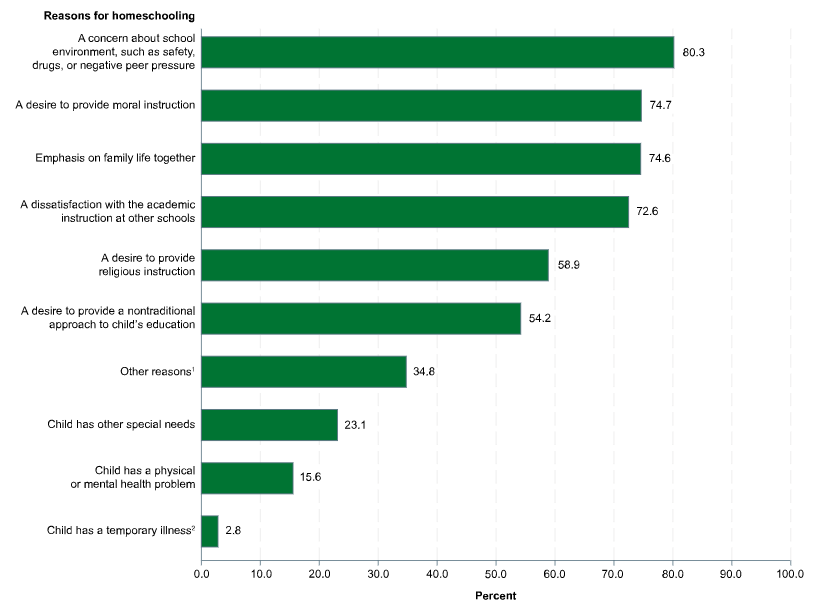
The reasons are no mystery. According to the U.S. Department of Education’s 2023 National Household Education Surveys (the most recent detailed national data), parents of homeschooled children cited the following as “important” factors (they could pick more than one):
Concern about the school environment (safety, drugs, negative peer pressure)
Dissatisfaction with academic instruction
Desire to provide moral instruction
Desire to emphasize family life
When asked for the single most important reason, “concern about the school environment” topped the list, followed by academic dissatisfaction.
Parents across the political spectrum report losing confidence in public school curriculum priorities. Many feel that social-emotional learning (SEL), diversity/equity/inclusion (DEI) initiatives, and identity-focused lessons promoted by teachers’ unions have come at the expense of core fundamentals—reading, math, critical thinking, and basic skills. National Assessment of Educational Progress (NAEP) scores in reading and math remain below pre-pandemic levels for many student groups, reinforcing the perception that public schools are prioritizing ideology over academics.
Safety concerns—bullying, violence, and classroom disruptions—remain front and center. Families also want more control over moral and religious values, something public schools are structurally unable to provide.
The result? Parents are choosing personalized, fundamentals-focused education at home or in private settings that align with their values.
Where the Shift Is Happening: Top States by Absolute Numbers
While percentage rates highlight intensity in smaller states, absolute numbers show where the largest raw shifts are occurring. California and Texas lead the nation due to their massive populations, though their figures are Census-based estimates (many families register as private schools instead of formal homeschool programs). Here are the latest 2024–2025 figures:
State | Homeschooled Students (2024–2025) | Notes |
California | 547,561 | Census estimate |
Texas | 440,666 | Census estimate |
North Carolina | 165,243 | Official report |
Florida | 152,871 | Official report |
Georgia | 89,510 | Official report |
Virginia | 62,763 | Official report |
Maryland | 42,151 | Official report |
Note: California and Texas lead in sheer volume, but many families there file under private-school affidavits rather than official homeschool counts, so the real totals may be even higher. The table combines official state-reported data (where available) with the most reliable Census-based estimates.
Private school enrollment varies more by region. Hawaii consistently has the highest percentage (~19–20% of K-12 students), followed by states like the District of Columbia, Louisiana, and parts of the Northeast. Post-COVID growth has been strongest in areas with access to school-choice programs or vouchers.
In California specifically, official homeschool filings understate the real picture (many families register as private schools), but Census-based estimates put it around 4.4%—still well above pre-pandemic levels.
Finding Financial Parity for the Home/Private School Families
Recent data puts the numbers in sharp focus: about 3.4 million children are homeschooled (roughly 6.3% of school-age kids), while private school enrollment sits around 5 million (approximately 10%). That adds up to nearly 9 million students whose families have opted out of public schools entirely.
These families still pay the full share of local, state, and federal taxes that fund public education—yet they receive zero return on that investment while shouldering 100% of the cost of their chosen schooling. That’s not equity; it’s a penalty for exercising parental choice.
Targeted federal regulations could fix this through proven, neutral mechanisms:
School vouchers or education savings accounts that follow the child, letting parents direct per-pupil funding to the accredited option that best fits their child’s needs.
Tax credits (refundable or non-refundable) for education expenses, giving working- and middle-class families immediate relief without new bureaucracy.
This isn’t about dismantling public schools—it’s about basic fairness. Parents who stay in the system already benefit from taxpayer-funded options. Parents who leave should not be forced to double-pay. States have already shown the model works; a federal framework would ensure consistency and portability across state lines while protecting against abuse.
Nine million kids and their parents have already voted with their feet. Washington should stop ignoring that reality and start treating educational choice as the civil rights and family equity issue it has become.
The Bottom Line
Public schools aren’t losing students because of random chance. They’re losing them because parents—Democrats, Republicans, and independents alike—are seeing what their kids are (or aren’t) learning, worrying about safety and peer culture, and deciding they can do better themselves or in a private setting.
The data is unambiguous: homeschooling and private schooling are no longer fringe choices. They are mainstream, growing alternatives that have become permanent fixtures of American education. The trend that began decades ago, exploded during COVID, and has now re-accelerated shows no signs of stopping.
Parents in Shasta County and beyond are proving that when public education stops delivering on fundamentals, safety, and family values, families will find another path. And they’re doing it in record numbers.
Bonus Video:


