
Maduro Captured by US Forces


Chaos, Celebrations, and Global Backlash Ensue
In a dramatic escalation of U.S. foreign policy under President Donald Trump, American special forces conducted a large-scale military operation in Venezuela early this morning, resulting in the capture of President Nicolás Maduro and his wife, Cilia Flores. The raid, which involved airstrikes on key military and infrastructure sites, has plunged the South American nation into turmoil while sparking international outrage and domestic political division in the United States. This article compiles the latest developments, on-the-ground reports, reactions from opposition leaders, concerns for U.S. expats in the oil sector, and sharp rebukes from Democratic lawmakers.
The Operation: A "Surgical Strike" Against a "Narco-State"
President Trump announced the capture via his Truth Social platform, declaring that U.S. forces had successfully apprehended Maduro during a "large-scale strike" targeting areas including Caracas, Miranda, Aragua, and La Guaira. Explosions rocked the capital, causing widespread power outages and prompting a national emergency declaration by Venezuelan authorities. Trump framed the action as a decisive blow against a regime accused of rigging the 2024 Venezuelan elections, running a "narco-state" involved in drug trafficking, and harboring ties to terrorist groups. Maduro faces indictments in the Southern District of New York for narco-terrorism, cocaine importation, and weapons possession.

U.S. Attorney General Pamela Bondi praised the military's precision, confirming the operation's alignment with existing legal pursuits against Maduro. The White House released photos purportedly showing Maduro in custody, with Trump scheduling a press conference at Mar-a-Lago for further details. Analysts have drawn parallels to the 1989 U.S. invasion of Panama, where General Manuel Noriega was similarly captured and extradited on drug charges.
On-the-Ground Reports: Chaos and Conflicting Narratives
Reports from Venezuela paint a picture of confusion and volatility. Locals described hearing explosions and sporadic gunfire, with military movements and curfews imposed in affected areas. Venezuelan Defense Minister Vladimir Padrino López condemned the strikes as "foreign aggression" and called for national unity, while Vice President Delcy Rodríguez demanded "immediate proof of life" for Maduro, whose whereabouts remain unconfirmed by Caracas officials.
Conflicting accounts suggest the capture may have been a negotiated surrender rather than a forced abduction, potentially to avert wider violence. Opposition supporters have erupted in celebrations, viewing it as the end of a dictatorial era, while regime loyalists express fear of instability. Humanitarian concerns are mounting, with potential refugee flows to neighboring countries like Colombia and Trinidad and Tobago. Oil markets remain watchful, as disruptions could spike global prices given Venezuela's vast reserves.
Opposition Leader María Corina Machado: Poised for Return?
The whereabouts of prominent opposition leader María Corina Machado remain undisclosed amid the upheaval. She had been in hiding in Venezuela for about 15-16 months to evade arrest and threats from the Maduro regime. In December 2025, she was secretly extracted to Oslo, Norway, to accept the 2025 Nobel Peace Prize, where she openly praised President Trump, reuniting with her family after nearly two years.
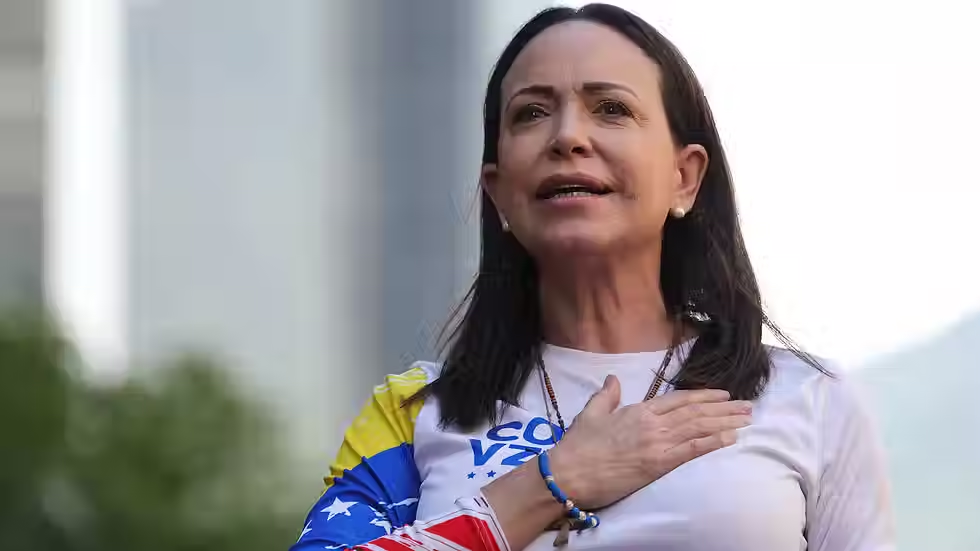
Sources suggest she could be in a secret location in Venezuela or still abroad, preparing for a return. Machado has outlined plans for a transitional government, including economic reforms, privatization of oil assets, and stronger ties with the U.S. and Israel. She has expressed support for U.S. pressure on Maduro and gratitude toward Trump. Critics accuse her of being a U.S. proxy, but supporters see her as a key figure in a post-Maduro era, potentially alongside Edmundo González Urrutia, currently in exile in Spain.
Safety Concerns for U.S. Expats in Venezuela's Oil Industry
The strikes have raised alarms for U.S. expatriate workers in Venezuela's beleaguered oil sector. While no direct harm to Americans has been reported, the chaos poses indirect risks from unrest, anti-U.S. sentiment, and infrastructure disruptions. PDVSA, the state oil company, claims key facilities remain operational and undamaged, as strikes avoided major oil hubs.
Chevron, the main U.S. firm operating there under special licenses, prioritizes personnel safety but continues activities. Accusations from Venezuelan allies of a U.S. "oil grab" could exacerbate tensions. The FAA has deemed Venezuelan airspace off-limits, and the U.S. State Department maintains a Level 4 travel advisory. Analysts warn of potential production drops of 10-50%, impacting global energy.
International and Domestic Reactions: Allies Condemn, Democrats Decry "Illegal War"
Venezuela's allies—Cuba, Iran, Russia, and China—have decried the action as a sovereignty violation and "illegal abduction," warning of regional escalation. Social media buzzes with debates, from praise for dismantling a "narco-terrorist hub" to fears of conflicts with major powers.
In the U.S., Democratic lawmakers have unleashed fierce criticism, labeling the strikes unauthorized and unconstitutional. Sen. Andy Kim (D-N.J.) accused administration officials of lying to Congress about regime change intentions. Sen. Ruben Gallego (D-Ariz.) called it an "illegal war," drawing from his Iraq experience to highlight unjustified costs. Rep. Jim McGovern (D-Mass.) questioned funding priorities, contrasting war expenses with domestic needs. Sen. Jack Reed (D-R.I.) demanded legal justification, arguing the military isn't a tool for extrajudicial pursuits. Efforts to limit Trump's authority via resolutions have been blocked by Republicans.
As the situation unfolds, questions linger over Maduro's trial location, transitional governance, and long-term U.S.-Venezuela relations. This bold move could redefine hemispheric dynamics—or ignite new conflicts. Stay tuned for updates.


