
American Patriot Series – Samuel Adams, The Man Who Kept the Revolution Alive

Thomas Jefferson called him “truly the Man of the Revolution.” Governor Thomas Hutchinson called him the greatest incendiary in the King’s dominions. Both were describing the same Bostonian: Samuel Adams, the organizer who turned local anger into a continental cause.

Adams was born in Boston on September 27, 1722, cousin of John Adams and heir to a malt-making family. He studied at Harvard and even argued, in a thesis, that it could be lawful to resist a supreme magistrate if the commonwealth could not otherwise be preserved. He was a poor businessman. He was a formidable politician. When Parliament imposed new taxes in the 1760s, he found his life’s work.
He helped found the Sons of Liberty, drafted resolutions against the Stamp Act, and used newspapers under names such as “Vindex” and “Candidus” to keep resistance burning when others wanted quiet. After the Boston Massacre of 1770, he confronted Governor Hutchinson and demanded the removal of British troops. John Singleton Copley’s portrait of about 1772 captures that moment: Adams pointing to the Massachusetts charter, petition in hand, crowding the viewer’s space.
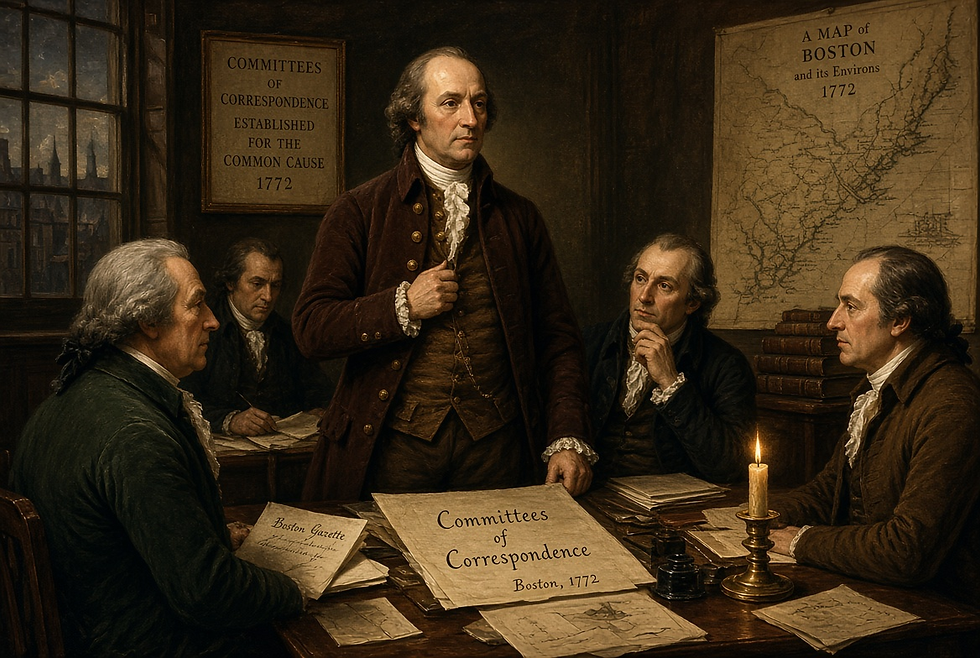
In 1772 he revived the committees of correspondence — first among Massachusetts towns, then among the colonies. The system became an extra-legal government the Crown could not dissolve. He was at the center of the crisis that produced the Boston Tea Party in December 1773. When British troops marched toward Lexington in April 1775, Paul Revere rode to warn Adams and John Hancock. They left hours before the first shots of the war.
Adams sat in the Continental Congress, signed the Declaration of Independence, and pressed early for a complete break with Britain. He helped draft the Massachusetts Constitution of 1780 and later served as lieutenant governor and governor of the commonwealth. He was neither a soldier nor a financier. He organized opinion, built networks, and refused to let the argument die.

He died in Boston on October 2, 1803, and was buried in the Granary Burying Ground. His cousin John became president. Samuel remained what Jefferson said he was: the man of the Revolution — the agitator without whom the famous names that followed might never have had a cause to lead.

In this series, he stands beside Paul Revere, Patrick Henry, John Adams, and Mercy Otis Warren as one of the architects of resistance itself.
Footnote:
Today, when many hear the name Sam Adams, they think of the popular Boston lager beer sold under his name. However, little evidence suggests that the real Samuel Adams was a brewer. Instead, he inherited a successful granary that malted barley that was used by beer brewers. His preoccupation with the cause of liberty allowed the business to fall into disrepair after his father's passing.


