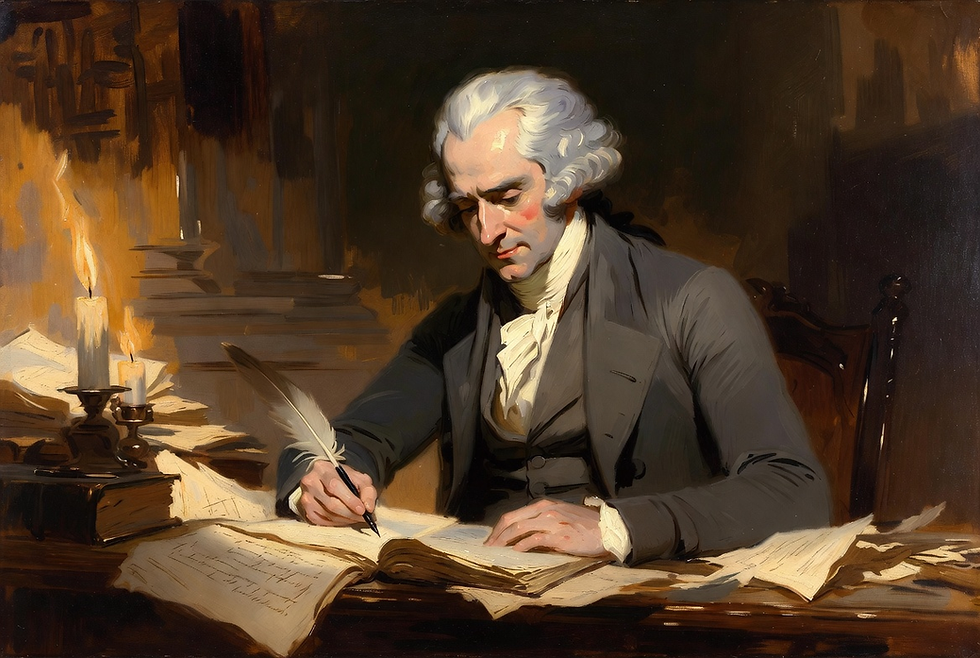
American Patriot Series - Marquis de Lafayette

Updated: Jul 28
The Hero of Two Worlds Who Crossed an Ocean for Liberty
It was not that long ago. Only a little more than a decade before the American Revolution began in earnest, a young George Washington had fought against the French as a British colonial officer in the French and Indian War (1754–1763). Washington had seen French soldiers as the enemy on the frontier. Yet history turned with astonishing speed. In 1777, a nineteen-year-old French aristocrat named Marie-Joseph Paul Yves Roch Gilbert du Motier — better known as the Marquis de Lafayette — defied his king, bought his own ship, and sailed across the Atlantic to fight for the American cause of liberty. The same nation Washington had once opposed as a young soldier would soon become America’s most critical ally, and Lafayette would become one of Washington’s most trusted companions.
Born on September 6, 1757, at the Château de Chavaniac in the Auvergne region of France, Lafayette was orphaned at a young age and inherited both a fortune and a military tradition. A British cannonball had killed his father during the Seven Years’ War — the same conflict that included the French and Indian War in North America. That personal loss, combined with Enlightenment ideals of liberty, fueled his passion when news of the American rebellion reached Europe.

At just nineteen, Lafayette ignored a royal decree forbidding French officers from serving in America. He purchased and outfitted the ship Victoire with his own money and arrived in South Carolina in June 1777. The Continental Congress, impressed by his enthusiasm and willingness to serve without pay, commissioned him a major general. He quickly joined George Washington’s staff and formed a deep, almost father-son bond with the American commander.
Lafayette’s first major combat came at the Battle of Brandywine on September 11, 1777. Shot in the leg while rallying American troops during a difficult retreat, he refused to leave the field until order was restored. Washington ordered special care for the young Frenchman. Their relationship only grew stronger through the harsh winter at Valley Forge.

Lafayette later returned briefly to France and successfully lobbied King Louis XVI for more substantial aid — troops, ships, and supplies that proved decisive. Back in America in 1780, he took command of forces in Virginia. In 1781, he skillfully shadowed and contained British General Lord Cornwallis, preventing escape while Washington and French forces under Rochambeau closed in. At the Siege of Yorktown, Lafayette’s troops held critical positions and helped capture key redoubts. On October 19, 1781, Cornwallis surrendered. The war for independence was effectively won.

Americans never forgot. When Lafayette returned for a triumphant farewell tour in 1824–1825, crowds of tens of thousands greeted him in every city. Congress made him an honorary U.S. citizen (a rare distinction later confirmed by modern legislation). He died in Paris on May 20, 1834, still devoted to the ideals of liberty he had first embraced as a teenager in America.

Why Lafayette Still Matters
Lafayette’s story is a powerful reminder that the American cause was never merely local. A French nobleman who had every reason to remain comfortable in Europe chose instead to risk fortune, rank, and life for a distant people’s freedom. He bridged the very recent bitterness of the French and Indian War and helped forge an alliance that tipped the scales at Yorktown. In an age when national loyalties were rigid, Lafayette showed that principle could transcend borders.
His life challenges us still: liberty is not owned by one people or one generation. It is a cause worth crossing oceans for — and worth defending at home.
Epilog
Flight, capture, and imprisonment (1792–1797)
Lafayette had been a leading moderate early in the French Revolution—helping draft the Declaration of the Rights of Man and of the Citizen and commanding the National Guard—while favoring a constitutional monarchy. As radicals (especially the Jacobins) gained power in 1792, the Legislative Assembly declared him a traitor.
He fled with some officers toward the Austrian Netherlands (hoping to reach America via the Dutch Republic). Austrian forces captured him. The Austrians and Prussians held him as a prisoner of war for more than five years, primarily at the fortress of Olmütz (Olomouc). Conditions were harsh; for roughly two years his wife Adrienne and two daughters shared the imprisonment with him. American efforts (including by George Washington and others) to free him failed.
Release and quiet years under Napoleon
Napoleon’s military successes and the 1797 Treaty of Campo Formio secured his release. He could not immediately return to France under the Directory. After Napoleon’s 1799 coup, Lafayette slipped back into the country and settled at the family estate of La Grange (southeast of Paris), living largely as a private gentleman farmer.
He refused offers of office under Napoleon and kept a low political profile, though he occasionally protested authoritarian measures. His citizenship was restored in 1800, and he recovered some property. Adrienne died in 1807. During the Hundred Days in 1815, he was elected to the Chamber and pressed for Napoleon’s abdication after Waterloo.
Later political role and final years
Under the Bourbon Restoration he returned to public life as a liberal deputy in the Chamber of Deputies, consistently advocating constitutional government, civil liberties, and opposition to absolutism.
In 1824–1825, at the invitation of President James Monroe, he made a triumphal 13-month tour of the United States as the “Guest of the Nation,” visiting all 24 states then in the Union and receiving a rapturous welcome.
During the July Revolution of 1830 he again commanded the National Guard, declined offers to become dictator or head a republic, and helped install Louis-Philippe as a constitutional (“Citizen”) king. He later grew disillusioned with the new regime’s conservative turn and resigned his National Guard command.
Lafayette died in Paris on 20 May 1834. He is buried in Picpus Cemetery under soil brought from Bunker Hill. He is remembered as the “Hero of Two Worlds” for his roles in both the American and French struggles for liberty, remaining a consistent advocate of constitutionalism and individual rights throughout a turbulent life.