
James Madison – The Father of the Constitution and Architect of American Liberty – American Patriot Series

Picture the sweltering summer of 1787 inside Philadelphia’s State House. The air is thick with frustration and the scent of candle wax. Delegates from thirteen quarreling states argue, sweat, and threaten to walk out as the young republic teeters on the edge of collapse.
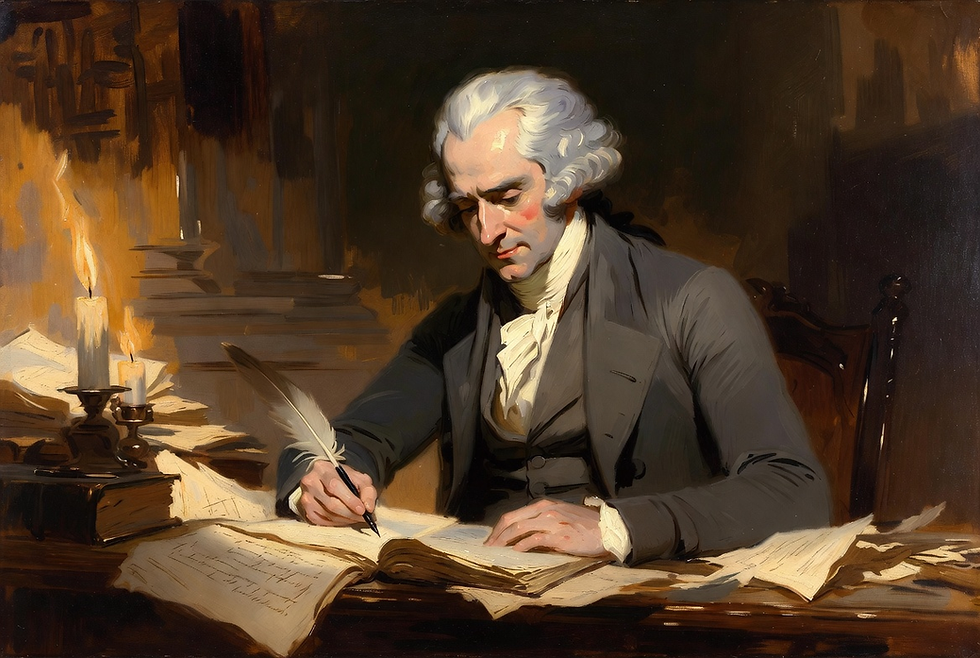
A slight, soft-spoken Virginian, barely five feet four inches tall and weighing less than 100 pounds, sits quietly taking meticulous notes. James Madison rarely raises his voice, yet when he speaks, the room listens. Over four long, grueling months, this unassuming scholar would lay the intellectual foundation for the world’s most enduring republic.
James Madison was born on March 16, 1751, at Belle Grove Plantation in Orange County, Virginia. The oldest of twelve children, he grew up on the frontier edge of British America. Frail and prone to illness as a boy, he compensated with an extraordinary mind. At the College of New Jersey (now Princeton), he studied history, government, theology, and ancient languages, graduating in just two years and staying on for graduate work. While most young men of his class pursued law or plantation life, Madison devoted himself to the great questions of governance.
When the Revolution erupted, Madison served in the Virginia legislature and the Continental Congress. He quickly recognized that the weak Articles of Confederation were failing. States acted like jealous sovereign nations, printing their own money, imposing tariffs on one another, and refusing to pay their share of war debts. In 1786, Madison helped organize the Annapolis Convention, which called for a larger meeting in Philadelphia the following year.
At the Constitutional Convention of 1787, Madison arrived with the Virginia Plan — a bold blueprint that proposed a strong national government with three branches, a bicameral legislature, and representation based on population. Though modified through fierce debate and compromise (including the Connecticut Compromise on Senate representation), the Virginia Plan became the structural heart of the final Constitution. Madison attended every session, took the most complete and accurate notes of the debates, and worked tirelessly behind the scenes to hold the convention together.

When the document was signed on September 17, 1787, many feared it would never be ratified. Madison joined Alexander Hamilton and John Jay in writing The Federalist Papers — a series of 85 brilliant essays published in New York newspapers under the pseudonym “Publius.” Madison authored roughly 29 of them, including the immortal Federalist No. 10 on the dangers of factions and Federalist No. 51 on the necessity of checks and balances: “Ambition must be made to counteract ambition.” 1
His next great battle was securing the Bill of Rights. As a Congressman in the First Congress, Madison personally drafted and shepherded the first ten amendments through a skeptical House and Senate. These protections of individual liberty — freedom of speech, religion, press, assembly, and due process — were crucial to winning over Anti-Federalist opponents and completing the constitutional framework.

In 1809, Madison succeeded his friend Thomas Jefferson as the fourth President. His presidency was dominated by the War of 1812 against Great Britain. Though the war brought early disasters (including the burning of Washington, D.C.), American forces ultimately held their own. Madison’s wife, the brilliant and charismatic Dolley Madison, became a national heroine when she saved Gilbert Stuart’s portrait of George Washington from the flames as British troops approached the White House.
After leaving office in 1817, Madison retired to his beloved Montpelier plantation. He continued advising later presidents, including James Monroe and John Quincy Adams, and served as rector of the University of Virginia. He lived long enough to see the nation he helped create celebrate its 50th anniversary. James Madison died peacefully on June 28, 1836, at age 85 — the last surviving signer of the Constitution.
A Man of Deep Principle, Madison was a champion of religious liberty. As a young legislator, he fiercely opposed Virginia’s tax support for established churches. He worked closely with Thomas Jefferson on the Virginia Statute for Religious Freedom (1786), which became a model for the First Amendment. He believed that true faith could only flourish when conscience was free from government coercion.

James Madison gave America its operating manual. He understood human nature better than most — that men are not angels, and therefore power must be divided, checked, and limited. Every time branches of government restrain one another, every time courts protect individual rights, every time Americans debate the proper limits of federal power, Madison’s careful architecture endures.
His story calls to every thoughtful citizen: study deeply, reason clearly, compromise wisely when necessary, but never surrender core principles. Build institutions that protect liberty not just for your own time — but for generations yet unborn.
Let Madison’s quiet brilliance and steadfast devotion inspire you: read the Constitution, defend its principles, guard religious liberty, and work tirelessly to preserve this remarkable experiment in self-government.
¹ The Federalist Papers and Madison’s leadership in creating the Bill of Rights remain foundational to American constitutional law and civic education. His writings and actions helped ensure that the United States would be a republic of laws, not of men — a nation where liberty and ordered government could coexist.


