John Jay – The First Chief Justice and Guardian of American Justice – American Patriot Series

In the winter of 1782, inside a modest Paris apartment, three American commissioners sat across from their British counterparts to negotiate the end of the Revolutionary War. John Jay, the tall, serious New Yorker, refused to accept terms that would leave the new nation weak or dependent. While others were willing to compromise, Jay insisted on full recognition of American independence, secure borders, and vital fishing rights off Newfoundland and Nova Scotia. His firmness helped secure one of the most favorable peace treaties in history.
That same principled resolve would later define his greatest contribution: establishing an independent federal judiciary as the guardian of the Constitution and the rule of law.

John Jay was born on December 12, 1745, in New York City, the sixth of eight children in a prosperous merchant family. His paternal grandfather, Augustus Jay, had been a French Huguenot who fled religious persecution in France after the revocation of the Edict of Nantes and arrived in New York in the 1680s seeking religious freedom. That heritage of resilience and faith in the face of tyranny would quietly shape John’s character for the rest of his life.
Only three months after his birth, the family moved from Manhattan to a large estate in Rye, New York, overlooking Long Island Sound. The move was driven by tragedy: a smallpox epidemic had already killed one of John’s siblings and left two others permanently blinded. Peter Jay, a successful merchant, retired to the healthier rural setting of “The Locusts” to raise his family away from the dangers of the city. Young John grew up surrounded by meadows, gardens, and the rhythms of country life.
His mother, Mary Van Cortlandt Jay, of prominent Dutch lineage, personally educated him at home until he was eight years old. At that point, he was sent to New Rochelle to study for three years under the French Huguenot Anglican priest Pierre Stoupe, an education that reinforced both his classical learning and his ancestral French language and culture. He later returned to Rye for further homeschooling under his mother and a tutor named George Murray.

In 1760, at the age of fourteen, Jay entered King’s College (now Columbia University) in New York City. There, he received a rigorous classical education in Latin, Greek, philosophy, history, and the natural sciences. He proved to be a serious and diligent student. At King’s College he formed important friendships, most notably with Robert R. Livingston of the powerful Livingston family. This relationship would prove highly significant, connecting Jay to influential New York networks and fellow patriots who would shape the revolutionary cause together.
After college, he began his legal training as a clerk in the office of Benjamin Kissam, one of New York’s leading attorneys. He was admitted to the bar in 1768 and quickly built a reputation for meticulous preparation, ethical conduct, and clear reasoning. Even in his early years as a lawyer, colleagues noted his calm temperament, strong sense of justice, and reluctance to be swayed by popular passion — traits that would define his entire public career.

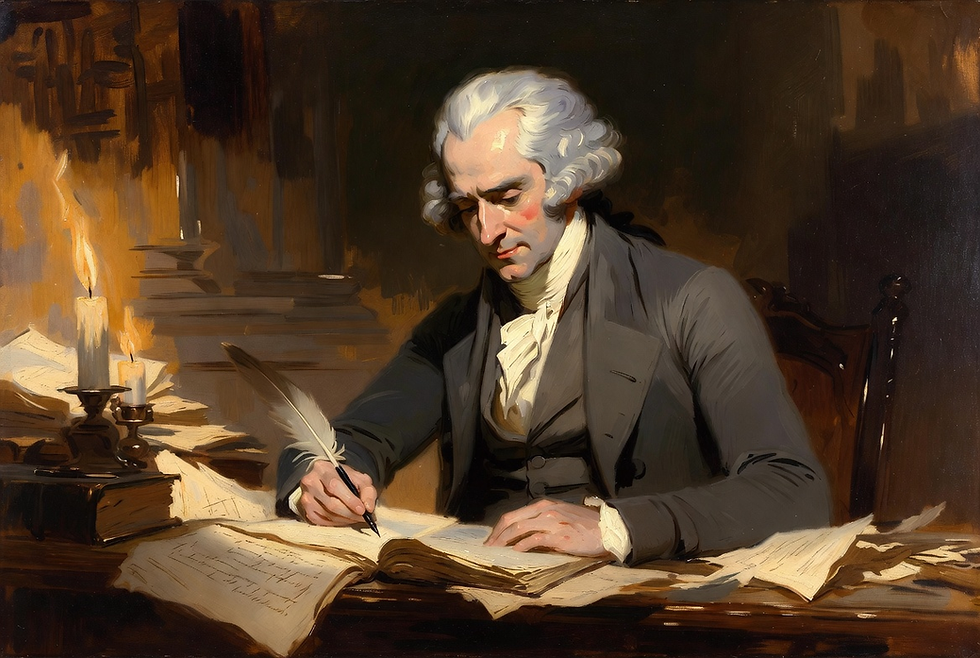
After the war, Jay became a leading voice for a stronger national government under the proposed Constitution. He joined Alexander Hamilton and James Madison as one of the three authors of The Federalist Papers, a series of eighty-five essays published in New York newspapers to persuade the states — especially skeptical New York — to ratify the new framework. Writing under the pseudonym “Publius,” Jay contributed five essays (Nos. 2–5 and 64). Drawing on his experience as a diplomat and negotiator of the Treaty of Paris, he focused on the dangers of foreign influence and the necessity of union for national security. In clear, forceful language, Jay argued that only a united America could effectively defend itself, conduct foreign affairs, and avoid being divided and exploited by European powers.
His essays reinforced the central theme that a strong, well-structured republic was essential not only for domestic order but for survival in a dangerous world.

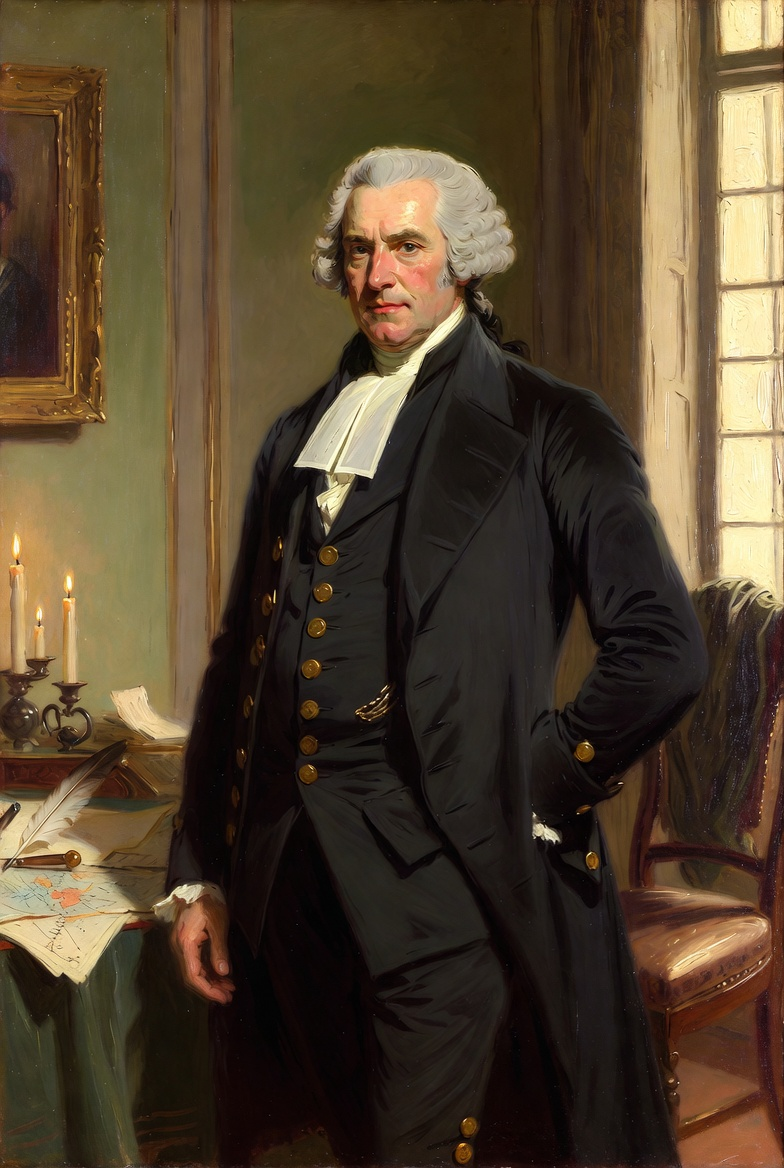
When the Constitution was ratified, President George Washington appointed John Jay the first Chief Justice of the United States Supreme Court in 1789. Jay essentially built the federal judiciary from the ground up. He established the Court’s dignity, procedures, and independence at a time when many still viewed it as secondary to the other branches. His service helped transform the judiciary into a co-equal branch of government capable of checking legislative and executive power — a cornerstone of American liberty.
Jay resigned from the Court in 1795 to become Governor of New York. Later, as a private citizen, he became deeply involved in the American Bible Society and devoted much of his retirement to religious study and charitable work. He died on May 17, 1829, at his home in Bedford, New York, at age 83.
A Legacy of Justice and Moral Order
John Jay understood that liberty without justice is fragile. He believed the rule of law, administered by independent courts, was essential to protecting the rights of individuals and preserving the republic. He saw the judiciary not as a political tool but as a steady guardian of the Constitution.
Like many of the Founders, Jay viewed moral and religious character as indispensable to self-government. He lived what he believed — serving with integrity in every role he was given and, in retirement, dedicating himself to the spread of Scripture and education.
John Jay’s life calls every American to cherish an independent judiciary, to respect the rule of law even when rulings are unpopular, and to remember that lasting freedom rests on a foundation of virtue and justice.
In our time, may we follow his example: defend the Constitution’s structure, support courts that decide cases on law rather than politics, and recognize that the blessings of liberty require citizens and leaders of strong moral character. Let John Jay’s steady hand in diplomacy and his pioneering work on the Supreme Court remind us that true patriots build institutions that protect freedom for generations yet to come.