21 Year-Old Dropout Created a $.5 billion Company
- Rex Ballard

- Dec 25, 2025
- 6 min read
In the rapidly evolving landscape of modern defense, few figures stand out as boldly as Ethan Thornton. At just 21 years old in 2025, Thornton has emerged as a prodigious force in the industry, founding and leading Mach Industries—a company that's not only challenging established giants but also reshaping how the United States approaches warfare. Born around 2004 in Orange County, California, Thornton's journey began on his grandparents' farm, where hands-on problem-solving ignited his passion for manufacturing and hardware.
As a teenager, he worked as an auto technician, using his savings to prototype defense technologies, and even founded Blue Oak Ironworks to hone his skills. His intellect led him to MIT, where he studied aerospace engineering, but he dropped out at 19 after receiving the prestigious Thiel Fellowship, channeling his energy into launching Mach Industries in 2023.
Thornton's rapid ascent has drawn comparisons to tech luminaries like Palmer Luckey of Anduril Industries, with media dubbing him the "Elon Musk of defense tech." Under his leadership, Mach has raised over $185 million in funding, including Sequoia's first defense investment, and achieved a $470 million valuation by 2025. The company's success is underscored by key U.S. Army contracts, such as the Strategic Strike program for vertical takeoff cruise missiles, and partnerships like the one with HevenDrones for hydrogen-powered UAS production. Yet, it's Thornton's visionary approach to asymmetric warfare that truly sets him apart, influencing every facet of Mach's innovations.

Ties to Peter Thiel and the Broader Political Ecosystem
Thornton's trajectory is inextricably linked to Peter Thiel, the billionaire co-founder of PayPal and Palantir Technologies, known for his libertarian views and skepticism toward traditional institutions. As a Thiel Fellow in 2023, Thornton received $100,000 to forgo college and pursue entrepreneurship, a decision that propelled Mach's founding. This fellowship, part of Thiel's initiative to back young innovators, aligns Thornton with a network of "Thiel protégés" who emphasize bold, unconventional solutions in high-stakes fields like defense.

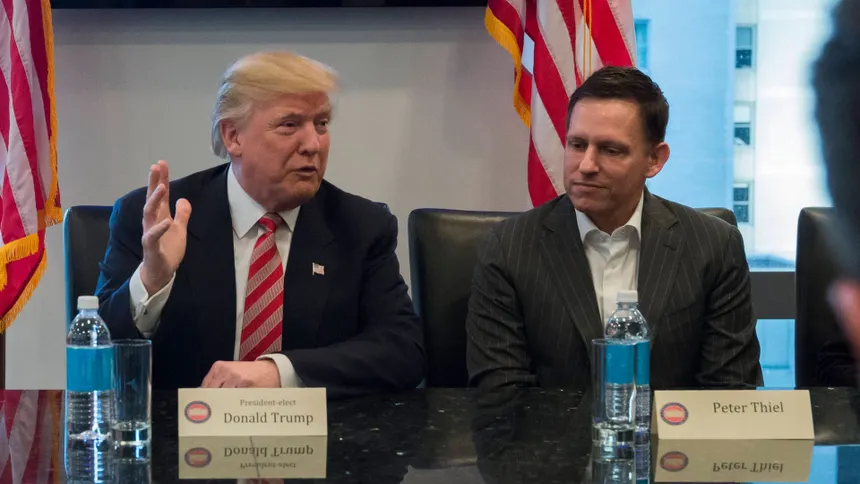
Photo L: Ethan Thornton, founder Mach Industries, Photo R: Peter Thiel with President Trump
Thiel's influence extends into politics, particularly his deep connections to the Trump administration. A vocal supporter since 2016, Thiel served on Trump's transition team, advising on technology and innovation. He donated millions to Republican causes, including funding JD Vance's Senate campaign—Vance, now Vice President, shares Thiel's orbit as a former employee at Mithril Capital. Palantir, Thiel's data analytics firm, secured significant federal contracts under Trump, benefiting from policies favoring tech-driven security solutions. Thiel's network, including figures like Elon Musk and Vivek Ramaswamy, continues to shape Trump's second term, promoting a "counter-elite" agenda that prioritizes deregulation and tech dominance. While Thornton himself maintains a focus on defense innovation, his Thiel affiliation places him within this influential ecosystem, potentially opening doors to government opportunities.
Thornton's Theory of Asymmetric Warfare: A Paradigm Shift
At the core of Thornton's philosophy is a forward-thinking theory of asymmetric warfare, which he sees as essential for the U.S. to counter peer adversaries like China in an era of great power competition. Drawing from conflicts like Ukraine, Thornton argues that future battles will be "almost exclusively an unmanned war," where centralized assets—such as aircraft carriers, runways, or traditional manufacturing hubs—become liabilities due to their vulnerability to precision strikes. He warns that "centralized manufacturing is going to be very, very difficult to defend just like a centralized aircraft carrier is," advocating for decentralization: "anytime you can take one asset and break it into 100 assets... you add a ton of survivability."
Thornton's theory emphasizes asymmetry through low-cost, mass-producible systems that overwhelm enemies via numbers and endurance, rather than relying on expensive, "exquisite" platforms. He points to Ukraine's use of cheap quadcopters as "bullets" and Intelligence, Surveillance and Reconnaissance (ISR) drones for long-range targeting, shifting warfare from artillery attrition to decentralized, attritional tactics. To offset adversaries', (such as China), manufacturing scale, the U.S. must "fight asymmetrically at least until we can once again match them or ideally exceed them in manufacturing capacity," using unmanned systems for "mass precision fires" at minimal cost.
This includes operating in Global Navigation Satellite System (GNSS) - denied environments, where GPS jamming is prevalent, and prioritizing survivability through proliferation and autonomy. Thornton's ultimate goal is "decentralized strategic capabilities that guarantee the defense of freedom worldwide," deterring conflict by ensuring overwhelming response capacity if needed.
He also integrates AI's role, noting it will "change warfare forever" by enabling autonomous targeting and decision-making, further amplifying asymmetric advantages. This theory critiques legacy defense models, pushing for speed, scale, and innovation to address supply chain vulnerabilities and rapid technological shifts. He is designing his own factories and manufacturing facilities to be small, agile and moveable, capable of being set-up or taken down quickly.
Influence on Product Development at Mach Industries
Thornton's asymmetric warfare theory directly informs Mach's product ecosystem, focusing on hydrogen-powered, unmanned platforms that are expendable, scalable, and infrastructure-independent. The company invents "the future of unmanned warfare by developing, manufacturing, and deploying asymmetric systems at unprecedented speed, scale, and endurance."
Central to this is the Viper, a jet-powered vertical takeoff loitering munition described as a "miniature fighter jet two people can launch." Optimized for long-range precision strikes on targets like artillery or tanks, it operates in GNSS-denied settings with EO/IR sensors and RF processors for autonomous acquisition. At under $100,000 per unit, its attritable design embodies asymmetry by enabling mass deployment without risking high-value assets.
The Glide complements this as a high-altitude, long-range munition for saturation strikes, modular for various launches and targeting 3,000 units monthly. Stratos, an in-air satellite alternative, provides persistent ISR and communications, enhancing decentralized operations. The Strategic Strike missile, under Army contract, combines HIMARS range with cruise missile speed, furthering low-infrastructure deep strikes.
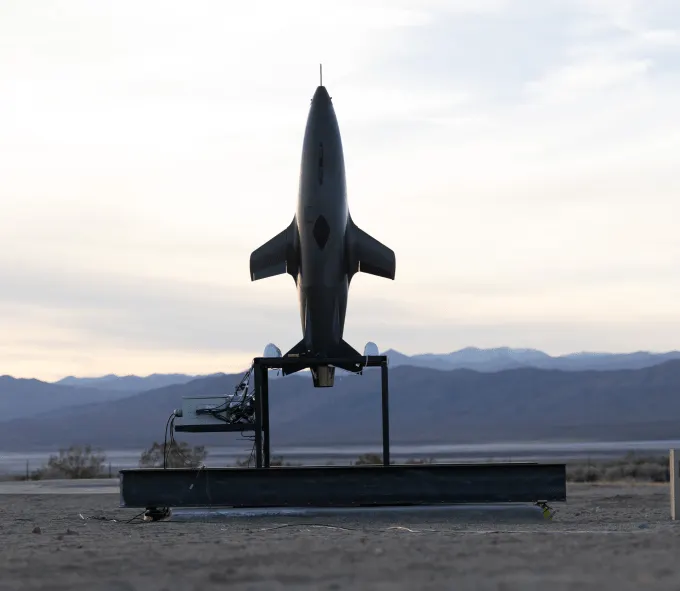


Photo L: Viper by Mach Industries - photo www.techcrunch.com Photo R: Glide by Mach Industries
Mach's development strategy—vertical integration of propulsion, avionics, and sensors—ensures control over supply chains, reducing vulnerabilities. The Forge network of decentralized factories supports this, enabling rapid scaling (e.g., 1,000 Vipers monthly) and survivability against disruptions. By aligning with DoD initiatives like Replicator, Mach turns Thornton's theory into deployable reality, positioning the U.S. for enduring asymmetric dominance.
Legal and Ethical Implications: Navigating International Humanitarian Law
While Thornton's theory and Mach's low-cost drone systems emphasize military precision, mass deployment, attrition and deterrence, their potential application to critical infrastructure—such as taking out power grids—raises questions about compliance with the Geneva Conventions and other treaties. The technology itself is not inherently violative, as violations hinge on usage rather than design; Mach's platforms target military objectives like artillery or command centers.
However, these technologies, that involve attritable drone swarms potentially being used against essential civilian infrastructure could breach core principles of International Humanitarian Law. We are seeing these types of strikes on both sides of the Russia/Ukraine conflict.
Legacy and Future Prospects
Thornton's blend of youthful ingenuity, Thiel-backed ambition, and strategic foresight has propelled Mach from startup to defense powerhouse in under three years. The company, although still private with venture capital backed funding is already seen as a potentially high value future public offering. Many financial industry experts already regard the company as having a $500 million valuation. As government contracts continue to be awarded you can expect to see the value of Mach Industries soar as well.
Sources:
The 19-year-old MIT Dropout 'Replacing Gunpowder' Published: Jul 13, 2025 TechCrunch interview with Ethan Thornton, founder of Mach Industries. Link: https://www.marque.vc/resources/external/techcrunch-mach-industries-ethan-thornton
Mach Industries and the Future of American Military Manufacturing Published: May 6, 2025 Interview with 21-year-old Ethan Thornton on YouTube by Weapons & Warfare. Link: https://www.youtube.com/watch?v=OAzZMSPzUyI
Mach Industries Business Breakdown & Founding Story No specific date listed. In-depth report from Contrary Research on Mach Industries' story and business model. Link: https://research.contrary.com/company/mach-industries
Retooling for the future of American military manufacturing Published: Mar 26, 2025 Interview with Ethan Thornton on enhancing U.S. military manufacturing. Link: https://san.com/cc/retooling-for-the-future-of-american-military-manufacturing-weapons-and-warfare/
Meet the 19-year-old MIT dropout 'replacing gunpowder' for the defense industry Published: Jul 13, 2023 TechCrunch article on Thornton's startup and Sequoia investment. Link: https://techcrunch.com/2023/07/13/meet-the-19-year-old-mit-drop-out-replacing-gunpowder-for-the-defense-industry/
Next Generation Strike UAVs with Ethan Thornton, CEO Mach Industries Published: Mar 28, 2025 Podcast interview on WRK Defined discussing next-gen UAVs. Link: https://wrkdefined.com/podcast/at-the-waters-edge/episode/23-next-generation-strike-uavs-with-ethan-thornton-ceo-mach-industries
Ethan Thornton: The Future of Warfare Published: Mar 15, 2025 YouTube conversation with Thornton on warfare's future. Link: https://www.youtube.com/watch?v=INXw8QVnQwc
Mach Industries: Investors gave a teen $85 million to build hydrogen weapons—it's not going well Published: May 26, 2024 Forbes article on challenges faced by Mach Industries. Link: https://www.forbes.com.au/news/innovation/investors-gave-a-teenager-85-million-to-build-hydrogen-weapons-its-not-going-well/
Ethan Thornton: The Future of Warfare Published: Mar 15, 2025 Article version of the conversation on Arjun Khemani's site. Link: https://www.arjunkhemani.com/p/ethan-thornton-the-future-of-warfare
Mach Industries CEO Ethan Thornton on the intersection of AI and defense Published: Nov 5, 2025 YouTube video discussing AI in defense. Link: https://www.youtube.com/watch?v=BiD-CmBKPysThe era of unmanned war is here.