
Supreme Court Signals Major Shift: Trump Poised to Gain Sweeping Power to Fire Agency Heads

December 9, 2025
In a high-stakes oral argument that could reshape the federal bureaucracy, the U.S. Supreme Court appears ready to hand President Donald Trump a significant victory, granting him—and future presidents—broad authority to remove heads of independent agencies without cause. The case, Trump v. Slaughter, heard on December 8, 2025, challenges the longstanding protections that shield commissioners of bodies like the Federal Trade Commission (FTC) from arbitrary dismissal. Based on the justices' pointed questions and comments, a conservative majority seems inclined to overhaul or outright overrule a nearly century-old precedent, potentially ushering in an era of heightened executive control over regulatory powerhouses.
The dispute centers on Trump's attempt to oust FTC Commissioner Rebecca Kelly Slaughter, a holdover from the previous administration, without specifying "inefficiency, neglect of duty, or malfeasance in office"—the statutory "for cause" requirement under the FTC Act. Trump's legal team argues this insulation violates Article II of the Constitution, which vests executive power in the president and mandates faithful execution of the laws. They seek to dismantle Humphrey's Executor v. United States (1935), a Depression-era ruling that upheld such protections for multimember commissions, deeming them quasi-legislative or quasi-judicial rather than purely executive.
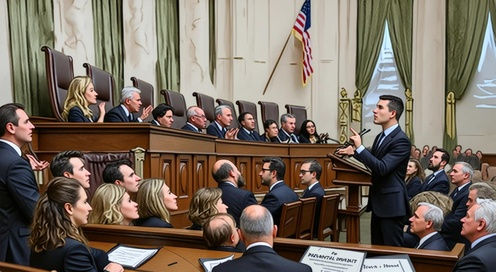
During the two-hour session, the court's conservative justices repeatedly grilled Slaughter's counsel on the limits of congressional authority to create "unaccountable" agencies, while showing sympathy for Trump's unitary executive theory. Liberal justices, in contrast, warned of chaos and politicization if presidents could fire regulators at will.
A Conservative Tilt: Probing the Boundaries of Independence
Chief Justice John Roberts, often the court's swing vote, emerged as a key figure signaling change. He described Humphrey's Executor as a relic, noting that the FTC's powers today far exceed the "vanishingly insignificant" roles envisioned in 1935. "Seila Law made pretty clear... that Humphrey's Executor is just a dried husk of whatever people used to think it was," Roberts remarked, referencing the 2020 decision that struck down similar protections for single-director agencies like the Consumer Financial Protection Bureau. This comment underscores his view that modern agencies wield too much executive might to remain insulated, supporting a likely ruling to expand presidential removal powers.
Justice Samuel Alito echoed this skepticism, peppering Slaughter's attorney with hypotheticals about converting cabinet departments into multimember commissions with for-cause protections. "I could go down the list... How about Veterans Affairs? How about Interior? Labor? EPA? Commerce? Education?" Alito asked, implying no principled line exists to prevent such encroachments on executive authority. His line of questioning highlights a theme: Without at-will removal, agencies could thwart presidential policy, violating separation of powers—a point that bolsters predictions of a pro-Trump outcome.
Justice Neil Gorsuch floated alternatives like reinvigorating the nondelegation doctrine but ultimately pressed on executive unity. "The President must have the authority to remove to ensure faithful execution," he stated, tying removal to the Constitution's Take Care Clause. Similarly, Justice Brett Kavanaugh emphasized the Vesting Clause, quoting Seila Law: "The first 15 words, 'The executive power shall be vested in a President... For the President to exercise that power he needs subordinates.' Otherwise, a subordinate could ignore the President's supervision." Kavanaugh's concerns about partisan entrenchment—imagining one party creating insulated agencies to hobble opponents—further suggest he'll join a majority favoring broader presidential control.
Justice Clarence Thomas, a staunch unitary executive advocate, directly challenged any permissible restrictions: "Could you give me one example... of a permissible restriction on the authority to remove a principal officer?" When told none exist for executive officers, he pressed on multimember bodies like the FTC, indicating no carve-out for them. Justice Amy Coney Barrett, focusing on history, noted early commissions lacked removal restrictions and had limited powers, contrasting them with today's FTC: "There's nothing that looks like the FTC at the time of Humphrey's." Her textualist lens points to overruling or narrowing the precedent.

Liberal Dissent: Warnings of Unchecked Power
The court's three liberal justices mounted a vigorous defense, emphasizing precedent, history, and risks. Justice Sonia Sotomayor highlighted independent agencies' roots: "Independent agencies have been around since the founding... This is not a modern contrivance." She cautioned against overturning a "nearly a hundred years" old case without stronger justification.
Justice Elena Kagan warned of "huge unchecked power in the hands of the president" if protections are severed, arguing Congress designed agencies assuming bipartisan stability. "If you take your logic at face value, it seems to include a great many things," she told Trump's counsel, probing extensions to civil service or courts. Justice Ketanji Brown Jackson tied insulation to Congress's Article I powers: "Removal restrictions ensure agencies serve the public interest, not political whims." Their exchanges reveal deep concern over politicizing expertise-driven regulation.
The Road Ahead: A 6-3 Ruling and Its Ripple Effects
Analysts predict a 6-3 decision along ideological lines, with Roberts authoring an opinion that severs for-cause provisions while preserving agencies—mirroring Seila Law. This would overrule Humphrey's Executor for most independent bodies but might carve out exceptions for quasi-judicial entities, as hinted by Roberts' nod to Wiener v. United States (1958). "The question is not whether the court will overturn Humphrey’s Executor, but how, and how broadly," observed legal scholar Will Baude.
Such a ruling could affect dozens of agencies, from the National Labor Relations Board to the Nuclear Regulatory Commission, making them more responsive to White House directives but vulnerable to political whims. Critics fear it erodes checks on executive overreach; proponents see it as restoring accountability. As one expert noted, "If petitioners get their way, everything is on the chopping block." With a decision expected by June 2026, Trump v. Slaughter may cement the court's conservative imprint on the administrative state, amplifying presidential power in an already polarized era.
References
Oral Argument Transcript - Supreme Court of the United States. https://www.supremecourt.gov/oral_arguments/argument_transcripts/2025/25-332_p8k0.pdf
Oral argument live blog for Monday, December 8 - SCOTUSblog. https://www.scotusblog.com/2025/12/oral-argument-live-blog-for-monday-december-8/
Supreme Ct. Hears Case on Executive Authority Amid Trump Firing ... - C-SPAN. https://www.c-span.org/event/public-affairs-event/supreme-ct-hears-case-on-executive-authority-amid-trump-firing-ftc-official/438407
LISTEN: Supreme Court hears Trump v. Slaughter, seems likely to ... - PBS. https://www.pbs.org/newshour/politics/listen-live-supreme-court-hears-trump-v-slaughter-in-another-test-of-presidential-power


