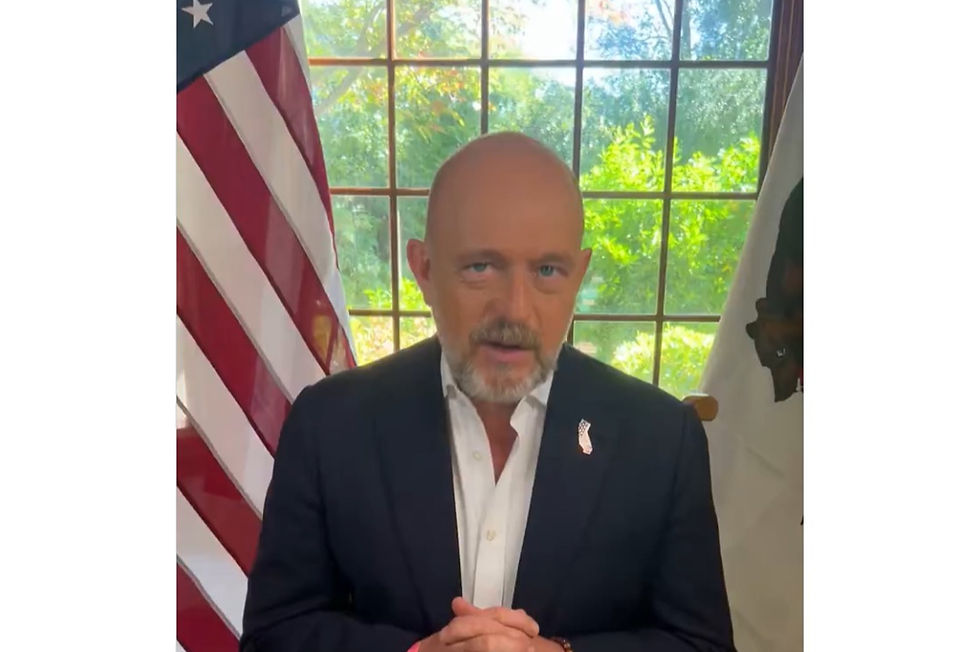
Steve Hilton’s AI Ads Declare War on California’s Democrat Machine — and They’re Brilliant

Opinion
California’s one-party Democrat machine has run the state into the ground for years: record gas prices, crushing taxes, rampant homelessness, failing schools, and a cost-of-living crisis that forces families out. Regular Californians have been told to accept it as inevitable.
Republican gubernatorial candidate Steve Hilton is refusing that script, and he’s doing it with some of the most creative, cinematic campaign advertising California has seen in a long time.
The ads, produced by filmmaker Charles Curran of Menace Studio (the same team behind the viral AI spots for Spencer Pratt’s Los Angeles mayoral run), use advanced AI video tools to create vivid, satirical political theater. They don’t soft-pedal. They name the problem as “The Machine” — the interlocking special interests, career politicians, unions, and bureaucrats in Sacramento that manufacture candidates and protect the status quo no matter how badly ordinary people suffer.
The People vs. The Machine
In the first major spot, released July 23, AI-generated versions of Gavin Newsom and Kamala Harris sit in a boardroom deciding the next governor. Newsom notes it’s time for him to move on to higher office and calls for “the machine.” The machine spits out Xavier Becerra. When someone questions the choice (“The Biden guy who lost all those kids?”), the response is essentially to run it again. Becerra is welcomed as the compliant product who will change nothing.
Intercut with real footage of homeless encampments, high gas prices, and struggling Californians, the ad builds to Hilton leading ordinary people in a fight against the mechanical monstrosity of the political establishment. The message is blunt: this is our state, not the machine’s. Hilton has said the ad captures “the people against the corrupt machine in Sacramento” and that government has been “hijacked by a group of special interests” while regular Californians lose out.
Are You Not Entertained?
The follow-up, released the next day, leans fully into Gladiator energy. Everyday working people are dragged into an arena to fight the same giant Machine robot while elite figures (resembling the usual Sacramento suspects) look on. The pleas are painfully familiar to anyone living in California: “Please, I just want to be able to afford a tank of gas so I can drive to work and feed my family.” “Me and my husband just want to buy a home together.”
Hilton appears in gladiator armor, steps in, and floors the Machine. The tagline lands hard: “Enough is enough. You shouldn’t have to fight for your life just to fill your tank, keep the lights on, and put a roof over your family’s head.”
These are not standard talking-head campaign spots. They are high-energy, visually striking, and unapologetically populist. They treat the Democrat machine as the actual antagonist — a self-perpetuating system that selects compliant figures like Becerra to keep the same policies (and the same failures) in place. Hilton positions himself as the outsider willing to take the fight to that machine on behalf of the people it has abandoned.
For Shasta County and the North State, the relevance is immediate. We live with the downstream effects of Sacramento’s priorities every day: energy costs, housing barriers, regulatory overreach, and a political culture that treats rural and inland California as an afterthought. When Hilton talks about $3 gas, cutting utility bills, making the first $150,000 of income tax-free, and restoring the California Dream for working families, he is speaking to problems that hit Redding, Anderson, Shasta Lake, and the surrounding communities as hard as anywhere in the state.
The ads have already drawn strong reactions. Supporters see them as the kind of bold, creative energy the race needs. Critics on the other side have predictably labeled them “slop” or worse, which is telling — the machine prefers voters remain passive consumers of the same tired messaging.
Hilton’s approach is a reminder that political communication does not have to be dull or defensive. When the status quo is this destructive, satire and spectacle can cut through. These AI-generated spots do exactly that: they make the abstract idea of “the machine” concrete, visual, and worth fighting.
California does not have to stay this way. The people versus the machine is the real contest. Hilton is making that contest impossible to ignore.
Enough is enough.