
Shasta County Supervisors Hear CORE Prevention Update, Veteran Homelessness Progress, and Major Federal Funding Impacts

REDDING — The Shasta County Board of Supervisors on Tuesday, August 25, 2026, received first-year updates on youth substance-use prevention programs, reviewed progress on reducing veteran homelessness, and examined the projected fiscal and operational impacts of federal legislation known as HR 1 on county social services. The meeting ran long, approximately 5 hours, as many other issues were addressed, including a new ADU (Additional Dwelling Unit) ordinance, public hearings to approve recovery of abatement costs and fines, and many public comments concerning election integrity.
Chair Chris Kelstrom presided, with Vice Chair Corkey Harmon, Supervisor Matt Plummer, and Supervisor Allen Long present. Supervisor Kevin Crye was absent while recovering from surgery.
CORE Program Reports Strong Engagement in First Year
The Community, Opioid, Response and Education (CORE) program delivered its one-year progress report, highlighting a shift toward relationship-based prevention rather than traditional lecture-style approaches such as DARE.
Program leaders emphasized three pillars: connecting youth with trusted adults, building adult capacity for difficult conversations, and coordinating community efforts. Opioid settlement funds supported the development of new evidence-informed curricula and infrastructure.
Key metrics shared included:
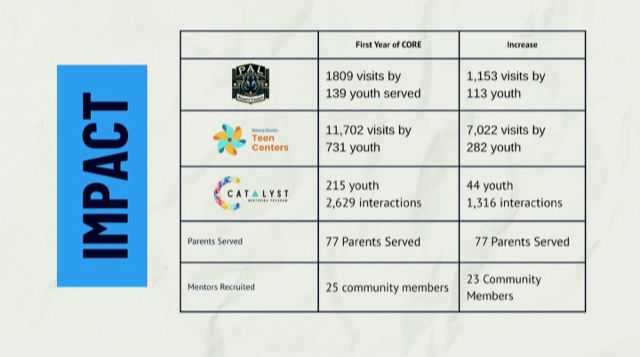
PAL boxing program: 1,809 visits by 139 youth, with one success story of a participant who moved from selling drugs to becoming a mentor.
Teen Centers: 11,702 visits by 731 youth.
Catalyst Mentoring Program: 2,629 interactions with 215 youth.
Parent services: 77 parents completed a new curriculum.

Youth Options Shasta reported that past-month substance use rises sharply from 5% in 7th grade to 20% in 11th grade. Its Peer Court processed 161 referrals with a 95% completion rate, while Aggression Replacement Training participants showed a 76.5% rate of quitting or reducing substance use. The program trained 167 youth educators, exceeding its goal of 60.
Catalyst/CalOS mentoring, offered in small groups during school lunch periods, continues to face waitlists. Officials aim to expand from a pre-COVID peak of 50 mentors to 100 this year, with a longer-term goal of 200.
Officials noted that true pre/post evaluation data was limited because baseline surveys began after programming started. Sustainability efforts focus on grants and private donors once opioid settlement funds end. A Peer Court recruitment event was scheduled for the evening of August 26.

Progress Reported on Veteran Homelessness
Christy Coleman, Director of the Health and Human Services Agency (HHSA) and Troy Payne of the Veterans Service Office presented the first annual report since the July 2025 “Call to Action.”
As of August 2026, 36 veterans were still waiting for housing through the county’s coordinated entry system — the shared intake and priority list used to match homeless people with available help, rather than sending them from agency to agency. Five of those veterans were classified as chronically homeless, meaning they have a qualifying disability and have been homeless for a long stretch. A January 2026 street and shelter count found 46 homeless veterans in Shasta County, down from 71 the year before. Separately, records in the Homeless Management Information System showed 44 veterans already had housing move-in dates, and 47 had received money meant to keep them from becoming homeless.
Outreach is continuing through partners such as the Hope Van. Nation’s Finest is the main housing provider for veterans. Officials said 10 to 15 new transitional housing beds may open soon, and the county reopened a Homekey Plus request for proposals for veteran housing, with applications due Oct. 12.
The standing message remains: if you see a homeless veteran, contact the Veterans Service Office at (530)225-5616. Officials also reported ongoing recruitment for an alcohol and drug counselor dedicated to the veteran population and plans to pursue additional grants, including support for a potential Veteran Treatment Court.
HR 1 Expected to Increase Workload and Costs
HHSA staff outlined significant operational and financial impacts from HR 1, signed in July 2025, which reduces federal Medicaid spending and expands work requirements for CalFresh (SNAP) and Medi-Cal.
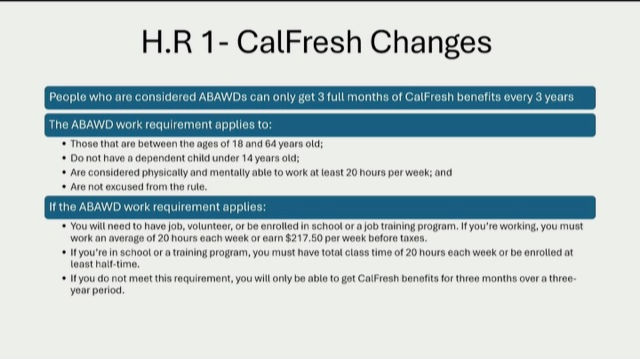
Under new CalFresh rules effective June 1, 2026, able-bodied adults without exemptions face a three-month time limit within a three-year period unless they meet work or training requirements. An estimated 6,000 of Shasta County’s roughly 30,000 recipients could be affected. A state waiver currently limits the county’s increased administrative cost share through fiscal year 2028–29, but a high state error rate of 10.93% could later expose the county to roughly $1 million in penalties if costs are passed down.
Medi-Cal changes beginning January 1, 2027, will require ages 19–64 without exemptions to complete 80 hours of qualifying activities monthly, reinstate asset limits, and shift eligibility reviews to every six months. Officials estimated 17,200 beneficiaries could be impacted, with about 5,676 subject to the new work requirements.
Narrowed Medi-Cal coverage is expected to increase demand on the County Medical Services Program (CMSP). Shasta’s roughly $300,000 cost-share, previously waived, is likely to return. The CMSP governing board is also considering reductions to certain benefits.
HHSA projected a need for 12 additional eligibility specialists (five for CalFresh and seven for Medi-Cal) and estimated total potential costs near $6 million when combining administrative increases, possible penalties, staffing, CMSP costs, and related service expenditures. A more detailed financial and staffing update is scheduled for October.
Board Actions and Appointments
The board presented a Certificate of Recognition to Sierra Pacific Industries’ Shasta Lake Mill for its 50th anniversary.
Letter of Support for SAVE Act
After public comment both supporting and opposing the measure, supervisors voted 4-0 to send a letter of support for the SAVE Act, which would add citizenship documentation and identification requirements for federal elections. Discussion included potential effects on vote-by-mail access in rural areas. Supervisor Long said he took a deep dive
into the proposed Act and was satisfied that the ID and citizenship verification requirements were not burdensome.
Supervisor Harmon Intends to Appoint New Planning Commissioner
An item to replace Planning Commissioner Steve Kearns with Kevin Butler was pulled from the consent calendar after public and board concerns about transparency and a possible conflict of interest linked to Butler’s engineering firm and a controversial gun range project. Supervisor Harmon, who proposed the appointment, said it was based on Butler’s professional experience and denied any improper connection. He also denied allegations that he did not consult with Kearns to inform him of his upcoming replacement. The board voted 4-0 to postpone the item until the next meeting in three weeks.
CEO's Report
CEO Dave Rickert reported that the inaugural 70.3 Ironman competition held in Shasta County on August 16 was a great success, bringing 1,700 athletes from around the world to our area. He stated that the Public Works Department provided guidance on selecting the bike route and was involved in several meetings with the Ironman group. Construction of 44 low-income senior apartment units, called "The Sunrise Cottages" has been approved in Anderson on the corner of North St. and Stingy Lane, with an estimated completion date of March 2028.
Supervisors' Reports
Matt Plummer pulled the Diablo Canyon/PG&E-related agenda item, pending advice from the Fair Political Practices Commission regarding a potential conflict of interest since he had received meals and lodging from PG&E during his attendance at the PG&E Local Leaders Energy Roundtable Program this year. Plummer also gave a report on his inquiry into the cause of homelessness, with information coming to light that 40% of homeless individuals are survivors of domestic violence. Some counties are participating in a pilot program that puts offenders in a 52-week program for rehabilitation. So far, there appears to be a 20% reduction in reconvictions for those completing the program. Plummer is also looking at getting more data on attempted suicides, coordinating with two hospitals in Redding. Regarding the need to find an alternative location for the Sheriff's proposal for an alternative custody program/men's reentry program and a 1200-bed jail project, Plummer requested a future agenda item to form an ad hoc committee to look for another site. His request was approved by a 3-1 vote (with Kelstrom dissenting). Harmon expressed interest in being on that committee.
In his report, Harmon stated he attended the Palo Cedro Park meeting and highlighted that the Honey Bee Festival is scheduled for September 26 and 27. He also thanked the HHSA Department for providing interim funding for Hill Country Clinic in Burney.
Long stated he met with concerned citizens regarding AI Data Centers. As of this date, he said there have been no inquiries from companies wanting to build an AI Data Center in Shasta County. Long also stated he toured the new courthouse and looked into a problem with the lack of handicap access; however, he stated that the County has no jurisdiction over this matter. He is awaiting the appointment of the new Redding City Manager to bring it to his or her attention. Long met with 80-90 people at the first town hall for his District 2 constituents. Code enforcement, roads, public safety, and law enforcement were the subjects discussed, with representatives from the Sheriff's Office, Fire Department, and other county departments in attendance to answer questions.
Kelstrom gave a brief highlight of meetings, events, and a veteran's funeral he attended, then he motioned to put on a future agenda a letter to end the current lease with the City of Redding for the property on Eastside Road that was the intended location of the correctional campus, now abandoned by the Sheriff due to concerns of the residents of River Ranch Neighborhood and the issues identified in the Environmental Impact Report. The motion passed 4-0.
Updated ADU Ordinance
To bring the county's zoning regulations into compliance with new California state laws concerning Accessory Dwelling Units (ADUs), the board adopted Zone Amendment 25-0003. This will allow combinations of up to three ADUs (attached or converted, junior, and detached) on a property, consistent with state requirements and supporting potentially four in residential and mixed-use districts. The revised regulations now allow up to a 1,200 SF detached ADU, regardless of the size of the main residence. (Shasta County previously capped ADUs at 50% of the primary residence.)
Abatement Hearings
Jonathan Muller, Code Enforcement Manager, presented on the county's request for cost and fine recovery for properties that have already been through the abatement hearing process. The board approved resolutions to recover all costs and fines for the following properties:
30818 Bambi Drive, Shingletown ($162,562.59)
20290 Sylvia Lane, Redding ($212,737.06)
Off Rock Creek Road, Redding ($54,196.45)
14800 Modesto View Court, Anderson ($131,444.70)
Violations for the above were well-documented and went through a lengthy process in which many attempts were made to enlist the owners' cooperation to clean up their properties for issues such as junk, sewage, and unpermitted grading. Liens will be placed on the above properties if fines and costs are not paid by the owners.
Public Comment and Closed Session
Public comment was extensive. Supporters of youth programs shared positive personal experiences. Views on HR 1 were mixed, with some expressing concern for vulnerable populations and others emphasizing work requirements for able-bodied recipients.

A significant portion of public comments focused on the Registrar of Voters, Clint Curtis, and election integrity. Supporters alleged irregularities including security protocol issues, fraudulent ballots, and called for further investigation or federal involvement. Critics of Curtis described the claims as costly and unfounded and urged stronger oversight or removal. White House press corps independent journalist Corinne Cliford said she has interviewed most of the supervisors and wanted to say that Corkey Harmon is the most true of all. She alleged that there are a lot of people getting paid to do what they do, so she wants to know where the money's coming from. She asked them to stand up for their constituents, the U.S. Constitution, and take the county back. She suggested the sheriff get a warrant and have a ballot authenticator publicly authenticate the ballots. Supervisor Harmon commented at the end of the comment period that he is willing to pay for an expert to examine the allegedly fraudulent ballots.
Other comments addressed a proposed tent encampment for the homeless, a veteran’s medical billing difficulties with Dignity Health, the accuracy of agricultural reports, and public access to meeting schedules. Leslie Sawyer of Moms for Liberty and Mountain Top Media announced her plans to prepare for a run for Supervisor Matt Plummer's seat in 2 years.
The board then recessed into closed session to discuss “initiation of litigation, one potential case.” One public commenter criticized the agenda language as insufficiently specific under the Brown Act. County Counsel Joseph Larmour stated upon returning from the closed session that the County would issue a press release addressing Clint Curtis's allegations.


