
Shasta County Board of Supervisors Tackles Wildfire Mitigation, Medical Education, and Budget Challenges in May 19 Meeting


Redding, CA (May 20, 2026) — The Shasta County Board of Supervisors convened its regular meeting on Tuesday, addressing a mix of public safety initiatives, long-term planning, fiscal pressures, and community health concerns amid ongoing local tensions.

Defensible Space Push
One of the opening presentations came from Chief Sean O’Hara on the rollout of stayreadyshasta.com, a new resource aimed at helping residents prepare for wildfires and a place to request inspections to determine compliance with defensible space laws. An ordinance was passed by the County Supervisors in September of 2025 that provided for enforcement tools (citations and fines) for noncompliance, which applies to properties in the unincorporated areas of the county. Key takeaways from the presentation were that it is up to every property owner to reduce wildfire fuel around their homes by maintaining a 30-foot buffer around structures (and 100-foot buffers in some cases). Defensible space maintenance requires keeping weeds and grasses trimmed to 4 inches or less, cutting tree stumps to a maximum height of 8 inches above the ground, removing dead, dying, or hazardous vegetation, and removing "ladder fuels" (by pruning lower tree branches to at least 6 feet above the ground). O'Hara also cautioned against mowing during hot/dry conditions, as it can start a fire.
UC Davis Medical School Proposal Sparks Discussion
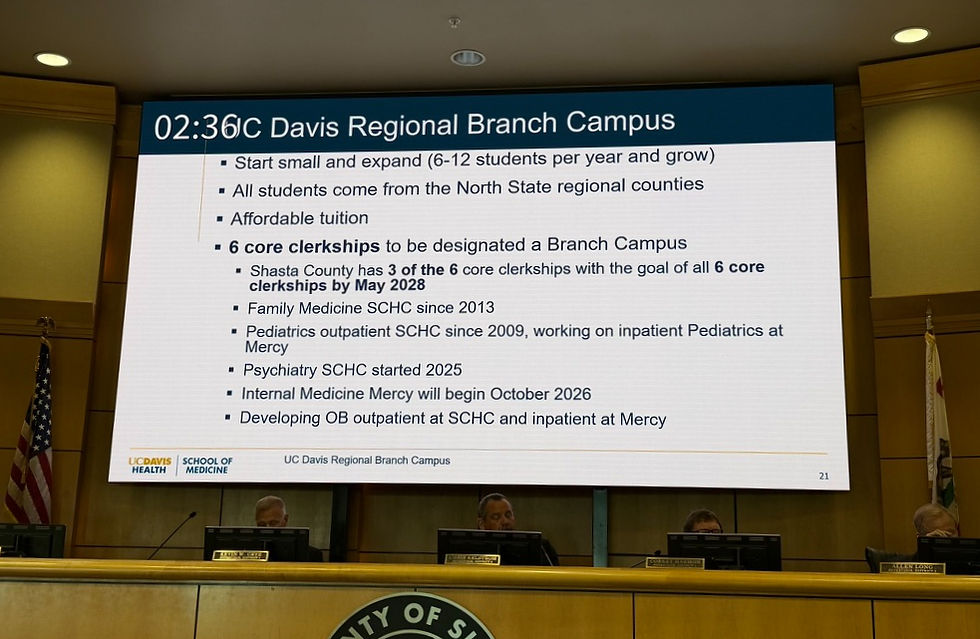
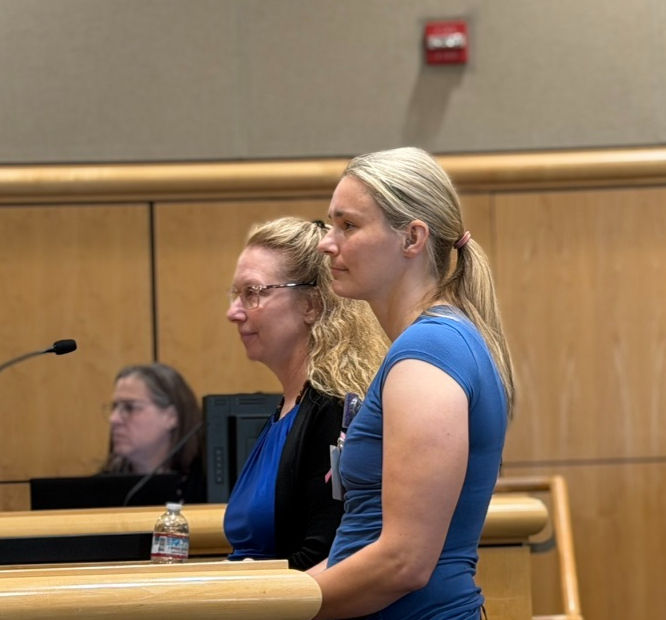
A major highlight was a presentation from representatives of the UC Davis School of Medicine (Doctors Debbie Lupeika and Amanda Mooneyham), sponsored by Supervisor Matt Plummer. They outlined existing partnerships in Shasta County and Northern California dating back to 1975, including residency and training programs with local facilities like Mercy Medical Center and Shasta Regional Health Center.
The discussion focused on the potential development of a regional branch campus in Redding to train 6-8 local medical students per year in an accelerated 3-year program, in partnership with healthcare leaders. Key elements included starting with clinical rotations, cost sharing, and students possibly enrolling as early as summer 2028. The location of the branch campus has not been determined. Still, UC Davis is talking with several other potential partners besides Shasta County, including Chico State, Butte College, and Touro University in Vallejo.
The proposal comes amid broader conversations about addressing doctor shortages in rural areas and competing or complementary ideas involving Simpson University. The physician shortage crisis in the North State will continue to worsen as more doctors in Shasta County reach retirement age. Dr. Lupeika emphasized her Redding roots and the desire to improve healthcare access in Shasta County; however, Supervisor Kevin Crye commented that he was disappointed that Dr. Mark Servis, Vice Dean for Medical Education at the UC Davis School of Medicine, was not in attendance at the meeting to answer questions about the financial aspects of the proposed branch. Dr. Lupeika also cautioned that the branch would need to have 6 clerkships (clinical rotations) in place for the third-year students.
Strategic Planning, Tourism, and Fiscal Issues
The Board received an update and voted unanimously to approve the county’s proposed 2026-2031 Strategic Plan, including status and goals. Two of the public commenters expressed disappointment with the plan. Community surveys found that public safety should be the County's top priority. Public speakers emphasized that the strategic plan's treatment of public safety falls disappointingly short, reducing it to a single ambitious yet narrow goal—the pursuit of a new Corrections and Rehabilitation Campus. While expanding alternative custody and treatment facilities addresses jail overcrowding and re-entry needs, reducing complex public safety challenges to a single building project risks overlooking immediate needs like funding and staffing the District Attorney's Office, enhanced street-level policing, prevention programs for youth and mental health crises, technology modernization, and fire mitigation efforts that residents also emphasized. This singular focus lacks a comprehensive, multi-pronged strategy with clear, measurable benchmarks for success, potentially leaving taxpayers with a costly capital project. At the same time, core issues like response times, recidivism tracking, and day-to-day community trust remain under-addressed. A more balanced plan would have treated the campus as one tool within a broader toolkit. Members of the committee who were responsible for the public safety aspect of the strategic plan development were Sheriff Michael Johnson, Supervisor Matt Plummer, retired Sheriff Captain Jeff Foster, and Shasta County Senior Administrative Analyst Jenn Rossi. Here is a link to the plan for further information: https://www.shastacounty.gov/county-administrative-office/page/strategic-plan
The location of the corrections campus is facing strong opposition and a lawsuit by the River Ranch Neighborhood Association. Many of the neighborhood's residents attended and spoke during public comment, including a mother and her three young children, who bravely spoke in opposition to the location of the correctional campus and jail.
Supervisors considered but did not approve a proposed $24,000 contribution (from contingency reserves) to the Shasta Lake Chamber of Commerce for a drone show to boost tourism and mark the U.S. Semiquincentennial (250th anniversary). The Supervisors expressed support for the drone show, but could not spend taxpayer money on it due to a fiscal crisis. Crye indicated he would be willing to donate as a private citizen to the drone show.
Significant attention was given to the Health and Human Services Agency (HHSA) budget crisis. Staff presented on the current state, prior cost-saving measures, and additional options. The Board approved extending a General Fund loan to the Social Services Fund (repayable by October 31, 2026) and increasing it up to $10 million to cover negative cash balances.
HHSA Director Christie Coleman and Administrative Branch Director Erinn Watts presented employee survey results indicating that at least 220 employees would be interested in being furloughed one day per month, which could result in substantial payroll savings. Discussions need to be held with labor union leaders before the Board of Supervisors proceeds with this potential cost-saving plan.
CEO Dave Rickert applauded the work HHSA has done so far on cost reductions. He stated that he will identify additional cost-reduction opportunities by reviewing 100 unfilled positions across the whole County. Supervisor Crye stated that this situation is due to the State's continual funding of benefits for illegal aliens, taking funds away from needed services at the county level for its citizens. Unfunded mandates are being unfairly imposed on the counties by the State, and all 13 rural counties are in a horrendous financial condition as a result. He stressed that new leadership is needed at the State level to stop the crisis.

Public Health Focus
The Shasta County Public Health Suicide Prevention Program presented key data, funding details, and ongoing activities at the Board of Supervisors meeting, highlighting several critical areas of concern.
Shasta County’s suicide rate is twice the statewide average, while the suicide rate among veterans is twice that of the general population.
Officials emphasized the urgent need to increase public awareness of suicide prevention resources, particularly the national 988 Suicide & Crisis Lifeline, which is available 24/7 for individuals experiencing suicidal thoughts or mental health crises.
Other Actions
Approval of engineering services and budget shifts for the demolition of the Old Shasta County Courthouse and parking lot redevelopment.
Routine items on the consent calendar, including child care planning priorities.
Standard public comment period and closed session items.
To watch the meeting in its entirety, go to:


