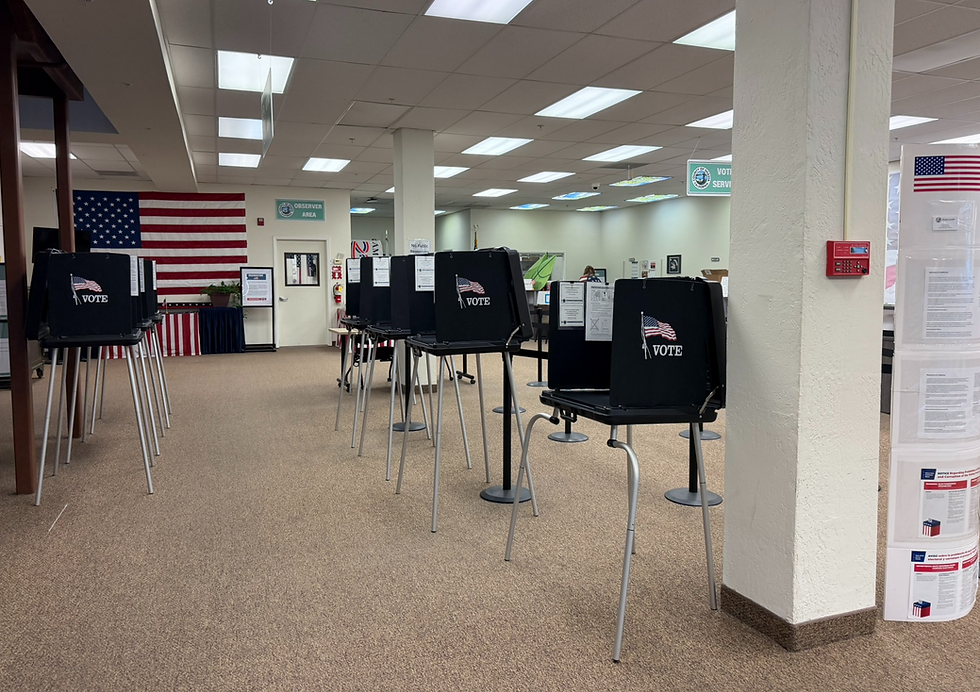
Major Problems I Observed While Monitoring the November 2024 Election Processing in Shasta County

For several days in October and November 2024, I served as a citizen observer at the Shasta County Elections Office located at 1643 Market Street in Redding. The processing of mail-in ballots for the November 5, 2024, election was overseen by Registrar of Voters Thomas Toller and Assistant Registrar of Voters Joanna Francescut. In my observations, Mr. Toller was never present in the office areas where the work was being conducted. He seemed to remain inside his own office, with the door shut. The day-to-day operations appeared to be managed primarily by Assistant Registrar Joanna Francescut.
Signature Verification Process:
Signature verification was conducted inside a closed room that observers were not allowed to enter. Outside the room, three large screens displayed the images election workers were reviewing. Each screen showed four ballot envelope signatures at once, along with a previously recorded signature for comparison. Notably, the voter’s party affiliation (Republican, Democrat, etc.) was also displayed on the screen. According to the California Code of Regulations, Title 2, Section 20960, election officials must not review or consider a voter’s party preference when verifying signatures. In my opinion, displaying party affiliation creates the potential for operator bias. The signatures were captured by the Agilis machine.
A “verify” button allowed workers to approve all four signatures at once. Some operators appeared to process signatures in approximately one second each. When a signature appeared questionable, workers could use a dropdown menu to view additional known signatures. I personally observed many questionable signatures being approved and brought my concerns to Mr. Toller's attention via email. He did not respond. I also spoke directly to one operator named Nick, who dismissed my concern.
Lack of Chain-of-Custody:
I observed open stacks of ballots throughout several rooms, often held together only with binder clips in groups of approximately 100. There were no visible tamper-evident bags or seals. Ballots were moved between rooms — including the “Bat Cave” tabulation room and the duplication room — without any documented chain-of-custody.

In the duplication room, two workers in the back corner were handling ballots, and one of them had a writing instrument in her hand, but their actions were not visible to observers. The ballot duplication machines frequently failed to capture accurate images, requiring manual review by two-person teams.

The “Bat Cave” Tabulation Room:
Four external screens allowed observers to view ballots that were being processed by the Hart tabulation machines. A high rejection rate (estimated at 70%) was occurring due to what I was told was a printing error by Runbeck Election Services (an Arizona-based company) involving overspray of invisible ink. This led to extensive ballot duplication work.
Treatment of Election Observers:
Observers were required to sign in and out, were escorted at times, instructed to remain quiet, and prohibited from using the restrooms inside the building. Security guards were present in the office.
No Changes After Public Comment:
After I raised the issue of signature verification problems that I observed in the Election Office during public comment at a Shasta County Board of Supervisors meeting, and personally handed Mr. Toller a copy of my earlier email, I returned to the Elections Office later that week to observe and found no noticeable changes in the speed or procedures of signature verification.
The above observations were put into an affidavit that I signed under penalty of perjury.
Additional Concerns:
Thomas Toller has publicly endorsed Joanna Francescut for the Registrar of Voters position. This is noteworthy given that the election he oversaw had significant discrepancies, including 2,783 more ballots tabulated than voters recorded as having voted. Francescut has attributed the discrepancy to provisional ballots, but this explanation does not appear consistent with standard election accounting procedures. If she is suggesting that the discrepancy is because provisional ballots were counted, then those ballots are no longer provisional and are now votes, which does not explain the discrepancy. There were also over 500 errors found in the 1% manual audit, although Francescut reported only 10 of the variances to the Secretary of State. Local election observers argue that the official report significantly underreported errors by including only certain types of variances while classifying many others differently. Other citizen election observers reported that on the last day of ballot counting, on December 3, 2024, at 5 p.m., they were told that all ballots had been counted and were told to leave the building. However, that evening, from 5 p.m. to approximately 9 p.m., two of the workers stayed to count hundreds of additional ballots they had suddenly discovered, without any citizens present to observe the tabulation, or witness where these found ballots came from.
Changes Made Under Clint Curtis as ROV:
Clint Curtis was appointed ROV after Toller resigned his position in April 2025. The changes that Curtis has made to the Elections Office are commendable and impressive, including installing cameras on all workstations, applying tamper-proof seals to ballot bags, implementing strict chain-of-custody protocols, and creating a comfortable observer's lounge and large screens for viewing every process. Additionally, in the last election conducted under Curtis, there were zero errors or discrepancies with the 1% manual audit. The signature verification process was highly observable, with citizen observers being allowed to sit directly behind the election workers.