
El Paso Airspace Temporarily Shut Down After Reported Mexican Cartel Drone Incursion
- Rex Ballard

- Feb 16
- 4 min read
Federal officials highlight escalating drone threats from south of the border as the military tests new counter-drone systems
EL PASO, Texas — February 15, 2026 — The Federal Aviation Administration briefly closed airspace over El Paso International Airport and surrounding areas this week after U.S. officials said drones linked to Mexican drug cartels breached American territory, prompting a swift military response.
The shutdown, which began late on Feb. 10 and lasted roughly seven hours, initially raised alarms when the FAA announced a 10-day restriction for "special security reasons." Flights resumed normally by midday Feb. 11 after authorities declared the threat neutralized.
Transportation Secretary Sean Duffy confirmed the official account in a statement: "The FAA and Department of War acted swiftly to address a cartel drone incursion. The threat has been neutralized, and there is no danger to commercial travel in the region."
The Pentagon and White House echoed the claim, stating that drones controlled by Mexican cartels had crossed into U.S. airspace near the border city. Military assets, including systems at nearby Fort Bliss, were deployed to disable the unmanned aircraft.

Conflicting Reports Emerge on the Trigger
Multiple sources familiar with the incident told major outlets, including The New York Times, CNN, and CBS News, that the closure stemmed in part from U.S. government testing of high-energy laser counter-drone technology. Customs and Border Protection (CBP) and Pentagon teams were reportedly evaluating systems designed to counter aerial threats when coordination issues with the FAA arose over potential risks to civilian air traffic.
Some accounts suggest the lasers may have targeted objects later identified as party balloons in test runs, though officials maintained the operation addressed a genuine cartel incursion. No wreckage or detailed evidence of the drones has been publicly released.
The episode underscored growing friction between agencies racing to deploy new defenses against a rapidly evolving threat.
Cartels' Drone Capabilities on the Rise
Mexican cartels, particularly the Jalisco New Generation Cartel (CJNG), have dramatically expanded their use of unmanned aerial systems (UAS) in recent years. What began as crude modifications to commercial quadcopters for smuggling has evolved into sophisticated operations.
Department of Homeland Security data indicate tens of thousands of cartel-linked drone flights along the U.S.-Mexico border annually, used primarily for:
Surveillance — Scouting Border Patrol positions.
Drug drops — Delivering fentanyl, methamphetamine, and other narcotics.
Aerial denial — Creating temporary no-fly zones for rivals or law enforcement.
In Mexico, cartels have weaponized drones more aggressively. Explosive-laden models—often FPV (first-person view) drones adapted from commercial tech—have been deployed in attacks on security forces, rival groups, and even government buildings. Cartel operatives have reportedly traveled to conflict zones like Ukraine to study advanced tactics, including jam-resistant fiber-optic guidance systems.
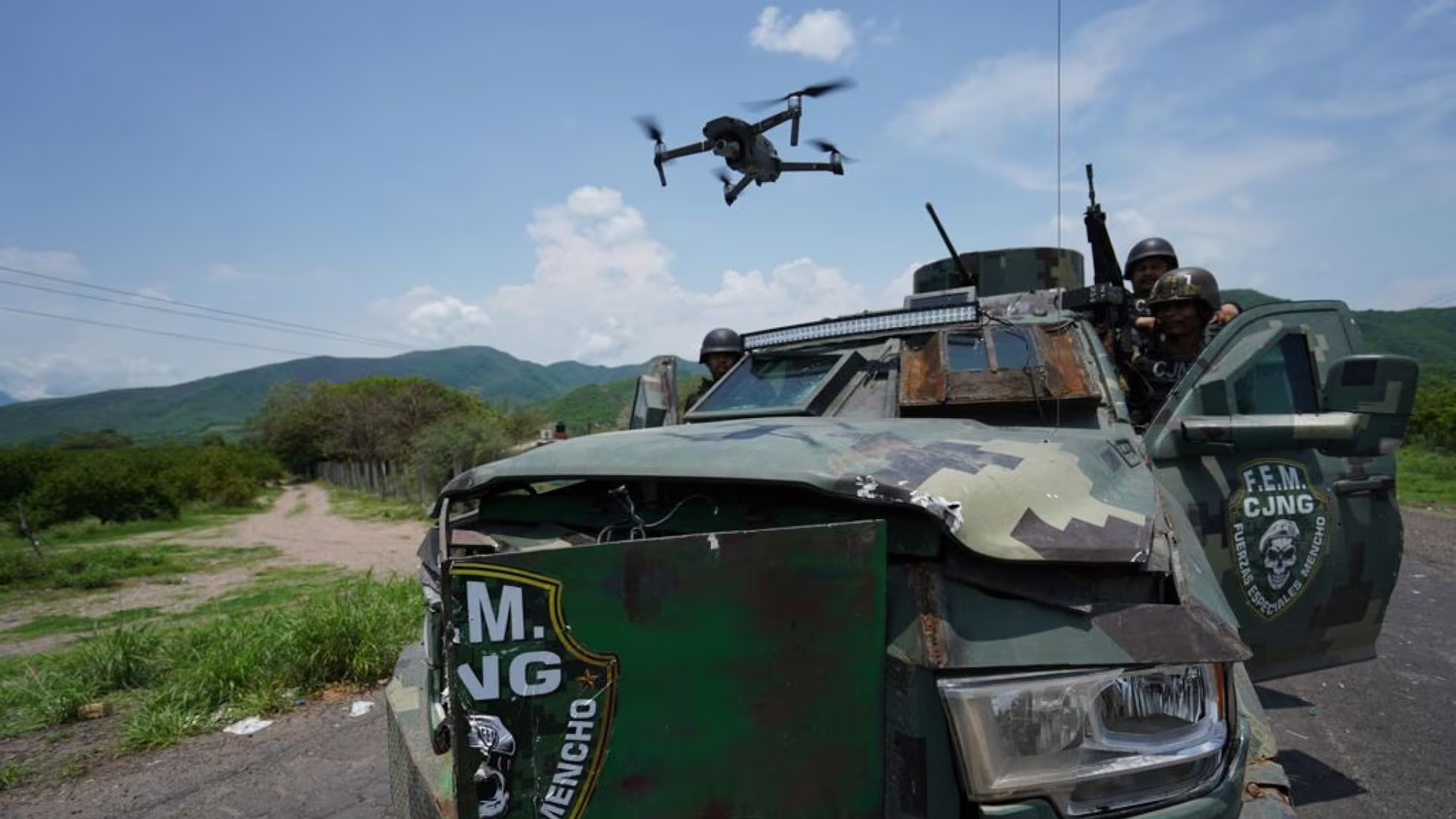


"Malicious actors in our backyard... are finding new ways to use drones to facilitate criminal activity nearly every day," a DHS counter-drone official testified to Congress last year. Experts warn it's "only a matter of time" before such tactics target U.S. soil or personnel directly.
Federal Government Accelerates Response
The Trump administration has made countering cartel drones a priority in its second term, framing the El Paso incident as evidence of the need for aggressive action.
Key elements of the response include:
Rapid deployment of directed-energy weapons — High-energy lasers (like systems tested near Fort Bliss) and microwave systems capable of disabling drone swarms.
Interagency coordination — Enhanced integration between FAA, Pentagon, CBP, and DHS to streamline testing and operations.
Border "drone wall" concepts — Proposals for layered defenses, including jammers, nets, and kinetic interceptors.
President Trump has signaled openness to broader measures, including potential military options against cartels, amid heightened U.S.-Mexico tensions.

Hands on with Raytheon's anti-drone laser weapon | Popular Science
A New Frontier in Border Security
The El Paso event, though short-lived, served as a wake-up call. With cartels innovating faster than regulators can respond, officials say the airspace incident may foreshadow more frequent disruptions—and a new era of aerial warfare along the southern border.
Local leaders in El Paso expressed frustration over the initial 10-day closure notice, which disrupted travel for thousands. "Drones along the border aren't new," El Paso Mayor Renard Johnson noted, "but the response highlighted coordination gaps we need to fix."
As the U.S. ramps up its counter-drone arsenal, the question remains: Can technology keep pace with the cartels' growing sophistication? For now, the skies over El Paso are clear—but the threat lingers just across the Rio Grande.
Sources:
Incident Reports & Timeline
New York Times (Feb 11, 2026) – Detailed on FAA closure, Trump admin claims, and counter-drone laser testing. nytimes.com/live/2026/02/11/us/faa-el-paso-flights-airport
Associated Press (Feb 11–12, 2026) – Pentagon-FAA dispute over laser tests; sources on balloons vs. drones. apnews.com/live/faa-el-paso-texas-air-space-closed-updates
CNN (Feb 11, 2026) – Military laser plans and safety concerns leading to shutdown. cnn.com/2026/02/11/us/faa-el-paso-texas-flight-restrictions-hnk
Reuters (Feb 12, 2026) – Cartel drone flashpoint and conflicting accounts. reuters.com/world/us/cartel-drones-become-flashpoint-between-us-mexico-2026-02-12
Official & Administration Statements
Transportation Secretary Sean Duffy (X post) – Direct claim of "cartel drone incursion" neutralized. x.com/SecDuffy/status/2021594420806639787
NPR (Feb 11, 2026) – Pentagon/CBP laser use and admin response. npr.org/2026/02/11/nx-s1-5711585/el-paso-airspace-drones-pentagon-faa
Cartel Drone Context & Broader Threat
New York Times (Feb 12, 2026) – Analysis of cartel drone usage and U.S. concerns. nytimes.com/2026/02/12/world/americas/mexico-drone-border-cartels.html
Texas Tribune (Feb 11, 2026) – Local impact and drone operations near Fort Bliss. texastribune.org/2026/02/11/el-paso-air-space-closed-faa
Fox News (Feb 11, 2026) – Admin perspective on breach and military action. foxnews.com/politics/mexican-cartel-drones-breach-us-airspace-disabled-war-department-duffy-says


