
The Briefing Room Fight Is About Viewpoint, Not Silence

Trump bans several news outlets from the briefing room, and several others walk out in solidarity.
Opinion Piece
Sherrill v. Knight is the card the banned outlets will play Wednesday. TRUMP TV is the unfiltered bypass the White House launched the same week. Those two facts do not cancel each other.
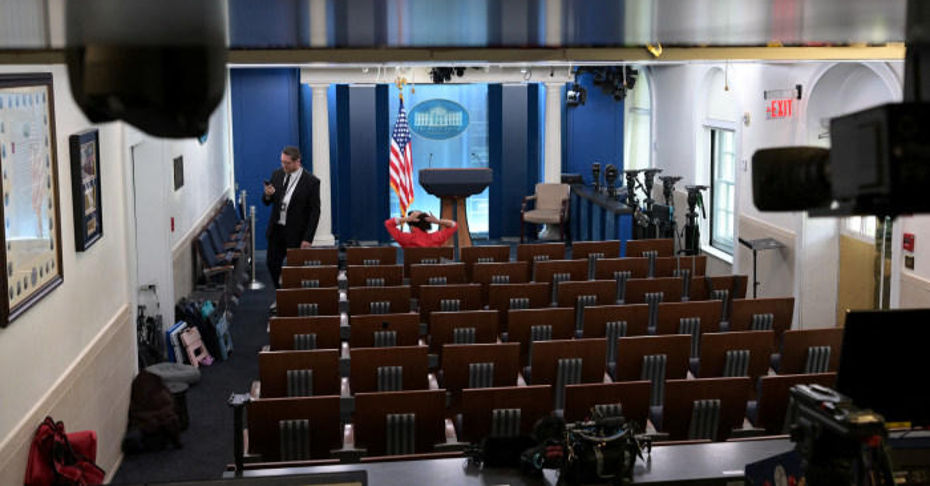
President Trump did not gag CNN, MS NOW, or Politico. He uninvited them from the White House after years of coverage his administration calls systematically hostile. That political diagnosis is easy to document. The legal problem is narrower, and the press knows it. Their case does not rest on a fantasy that the First Amendment entitles every network to a West Wing desk. It rests on Sherrill v. Knight and a half-century of D.C. Circuit law that says: once the White House opens the Brady Briefing Room to the press as a class, it cannot throw named outlets out because of their viewpoint.
That is the argument that will be before Judge Timothy Kelly on Wednesday. It is also the argument the White House should take seriously—even if one agrees the coverage has been lopsided.
What Sherrill actually gives the press
In 1977, the D.C. Circuit decided Sherrill v. Knight. Robert Sherrill of The Nation had House and Senate credentials but was denied a White House pass “for reasons of security,” with no published standard and no explanation. The court did not hold that journalists have a right to enter the complex. It said the opposite: the White House need not open press facilities, hold briefings, or keep a press corps on the grounds. The President may still grant interviews to selected reporters.
The constraint is what happens after the government creates those facilities and treats them as open to bona fide Washington correspondents. Then, the court said, newsgathering protection “requires that this access not be denied arbitrarily or for less than compelling reasons.”
Arbitrary or content-based criteria for press passes are forbidden. A correspondent’s interest in the pass is a First Amendment interest and a Fifth Amendment “liberty” interest. Before denial or revocation: notice of the facts, a chance to rebut, and a written decision a judge can review.
Later cases tightened the frame without overturning it. Karem v. Trump (2020) treated a hard pass as a liberty interest that cannot be suspended on after-the-fact, unpublished rules. The 2018 Acosta fight—heard by the same Judge Kelly now assigned to this case—turned on that process failure. In Ateba v. Leavitt (2025), the D.C. Circuit said Sherrill’s press area fits modern doctrine as a nonpublic forum. Restrictions must be viewpoint-neutral and reasonable. In the 2025 Associated Press fight, the same circuit drew a line: the President has wide discretion over tight spaces such as the Oval Office and Air Force One; he cannot exclude journalists from the briefing room and other spaces “generally open to the press” because of their views.
That is the line the banned outlets will take to court.

.
Why their case is strong on this record
CNN, MS NOW, and Politico are not suing over a security check or a seating chart. They are suing over a Truth Social post that named them, called their work “fake news,” “fiction and lies,” and “purposely negative stories,” and announced a ban “effective immediately.” The next morning badges were dead. No Sherrill notice, no hearing, no written application of a published standard to Betsy Klein, Akayla Gardner, or Cheyenne Haslett.
Two problems stack.
Process. Sherrill and Karem are at their strongest here. A same-day lockout of existing hard-pass holders, with the President’s own words as the only rationale, looks like the Acosta and Karem facts with the volume turned up. Even a judge sympathetic to executive control of the building can grant a temporary restraining order on due process alone and restore credentials while the bigger fight continues.
Viewpoint. This is the harder hit for the administration. Sherrill forbids content-based pass criteria. Ateba requires viewpoint neutrality in the briefing room forum. Trump did not say these reporters failed a background check or broke a published conduct rule. He said their stories were too negative. Vice President Vance cited Media Research Center (MRC) data that ABC, CBS, and NBC evening news were 92 percent negative in the first 100 days of the second term—useful politics, dangerous law. Using “your coverage is hostile” as the reason to close the door is the definition of viewpoint discrimination once the forum is open.
That does not mean the networks were fair. MRC’s contrast with Biden-era coverage, the Russia-collusion years, the laptop episode, and collapsing cable ratings are fair subjects for an independent paper. The ban's method—naming outlets and tying the penalty to editorial slant—gives plaintiffs their best facts. Courts do not need to like CNN to hold that the government may not condition access to an open press hall on friendlier copy.
Expect the outlets to argue retaliation as well: the ban was meant to coerce better coverage and deter others. Trump’s threat that “other fake news media outlets” would follow feeds that claim.

Where the press case is weaker
Sherrill is not a blank check. It never required the President to keep the briefing room open. It never required equal access to the Oval, the cabin of Air Force One, or a one-on-one. It never said speech is silenced when a badge is pulled; publishing from the sidewalk remains fully protected. The White House line—“access is a privilege, not a right”—is correct as far as it goes. The First Amendment stops prior restraint. It does not lease square footage in the West Wing.
Organization-wide bans from the entire complex are also a poorer fit for a 1977 case about one reporter and the Secret Service. The administration will argue that no constitutional right gives special proximity and that the President may choose his interlocutors. Those points are strongest about restricted spaces. They are weakest in the Brady Room, the press workspaces, and the daily hard-pass gate—spaces the D.C. Circuit has already called generally open to the press.
So the likely near-term outcome is not “CNN is abolished.” It is a process order, and quite possibly a ruling that a viewpoint-based ejection from the open press forum cannot stand. A loss would not force the White House to treat those networks as trusted partners. It would force a different tool.
TRUMP TV: The Essentials Station — unfiltered, on purpose
Monday evening, the White House stopped waiting for the pool. It launched TRUMP TV: The Essentials Station, a 24/7 livestream on the official White House YouTube channel and on WhiteHouse.gov. Digital strategist Kaelan Dorr called it “a 24/7 livestream of the Administration’s greatest hits, unfiltered.” The pitch was blunt: traditional outlets had “reported inaccurately or not at all” on what the administration calls record-breaking accomplishments. The first block opened with Trump’s July 3 Mount Rushmore address and rolled through inauguration footage and later live windows such as the U.N. General Assembly. No anchor. No overlay explaining why the policy is secretly a disaster. Just the remarks.

Hostile outlets raced to call it a flop because concurrent livestream counts started in the low thousands and fell overnight. That is a cable-ratings test applied to the wrong product. The White House YouTube channel already had more than 3.3 million subscribers before the branding push. The Essentials Station live listing showed about 1.6 million views and more than 52,000 likes within two days of launch—on a government channel, not a primetime entertainment network. Americans were already watching official speeches, bill signings, and rallies on YouTube, Truth Social, and X. Packaging that feed as a standing station makes the bypass explicit.
The lack of filter is the point, not a bug. Viewers hear the sentence the President actually said before three producers decide which eight percent of the story can be positive. Critics will scream “state TV.” Every White House has run an official channel and a press office. This one stopped pretending that three specific organizations were neutral observers entitled to a desk. CNN and MS NOW both saw prime-time audiences shrink in 2025 after riding Trump coverage to highs in his first term. The audience that wants the raw feed already exists. TRUMP TV is built for that audience.
That is also why the stream matters to the Sherrill fight. A president who speaks from his own channel is using the discretion the D.C. Circuit already said he has: he may choose how and with whom he communicates. He does not need CNN’s camera to reach the public. He does need to stop using an open briefing-room forum as a punishment hall. The stream is the lawful half of the strategy. The named-outlet ban is the half that walks into court Wednesday.
The safer path the administration can still take
If the goal is to stop hosting a permanent opposition shop in the people’s house, Sherrill itself points to the lawful route.
Do not keep the briefing room as a general press forum and then pick winners by ideology. Stop using it that way. Hold fewer indoor briefings. Speak from spaces courts already treat as the President’s choice of audience—the Oval Office, travel, invitation-only events. Lean on TRUMP TV and other official streams. Change pool logistics on viewpoint-neutral, operational grounds. Revoke or deny passes only under a published standard, with notice and a written decision.
That path is less theatrical than a Friday Truth Social ban. It is also the path Sherrill left open: the White House never had to create the room; it is not required to keep filling it. What it may not do, once the room is the press’s regular hall, is post a sign that says non-hostile coverage is the price of admission.
The press will call any of this “state media.” The Essentials Station is already running without them. The legal question is not whether legacy networks deserve a monopoly on the first draft. It is whether a president who has opened a forum may police that forum by viewpoint. On that question, the Sherrill line is the press’s strongest card—and the reason a narrower strategy may be best, since the one now streaming 24/7 will be harder to enjoin.


