President Trump Asks for Documents from New California State Movement -Town Hall Outlines Constitutional Statehood Strategy and Governance Accountability


Redding, CA — October 17, 2026
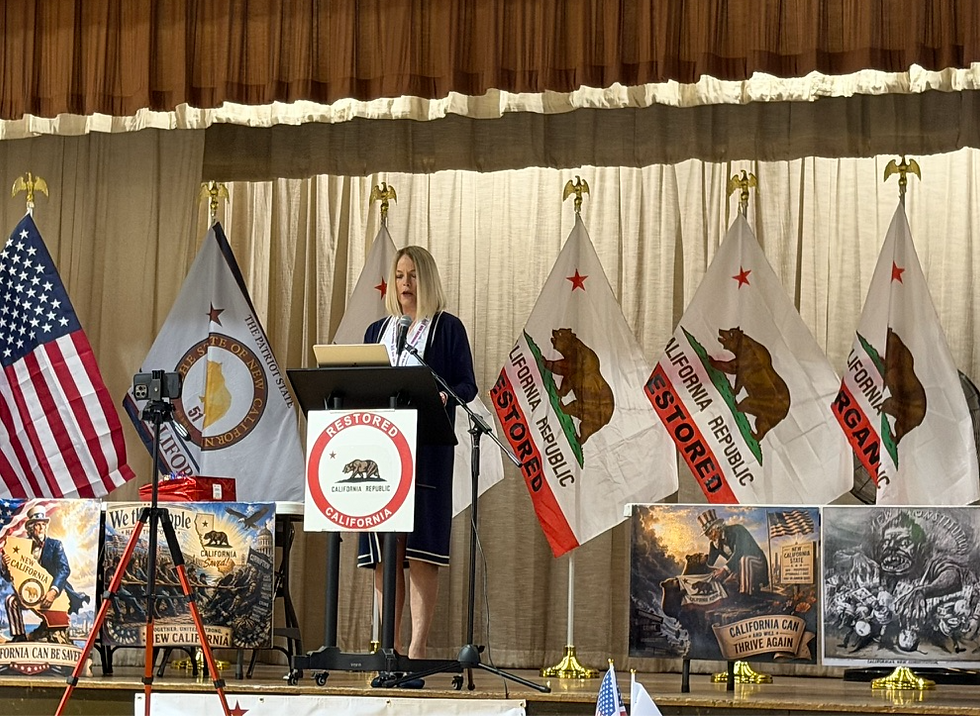
On Saturday afternoon, Paul Preston led a town hall at the Red Lion Hotel before a crowd of about 40 residents. Preston is the founder, president, and self-styled governor pro tempore of New California State. A Northern California radio host and former educator, he has led a multi-year effort to form a new 51st state from most of California’s rural and inland counties. The movement, which Preston and supporters formally launched with a declaration of independence in 2018, argues that California has become ungovernable under long-term Democratic control. It cites Article IV of the U.S. Constitution—along with the Civil War-era process that created West Virginia—as the legal pathway for creating a new state rather than seceding from the Union. Preston has held town halls and conventions across the state to advance the proposal, which would leave the densest coastal urban areas in the existing California while forming what supporters describe as a more republican, lower-tax alternative.
Preston outlined the movement’s constitutional foundation and procedural roadmap under Article IV, Section 3 of the U.S. Constitution, which governs the creation of a new state from an existing one and requires consent of the existing state legislature and approval by Congress. Organizers contend that the Founding Fathers intended Article IV, Sections 3 and 4, to preserve a republican form of government and to provide a remedy if that form collapses. They argue that the 1879 California Constitution shifted the state toward an administrative corporate structure and away from the original 1849 compact constitution, replacing a constitutional republic with models closer to direct democracy. Preston emphasized that democracies never work in the long run and the Founding Fathers knew this, having studied ancient history and political theory, learning about "tyranny of the majority" in pure/direct democracies.
To pursue statehood, the movement has prepared a 17-page state constitution and an Admissions Act framed as a congressional House resolution seeking admission of New California on equal footing with other states. Under the movement’s proposed process, the President would certify the act to the Governor Pro Tempore within 60 days of enactment. Within 30 days of that certification, the Governor Pro Tempore would issue a proclamation ordering statewide elections by paper ballot to select two U.S. senators and House members (projected at roughly 35 representatives under reorganized maps). After certification of results and a presidential proclamation, the elected delegation would take their seats. Organizers also described contingency steps under the historical “Tennessee Plan,” in which senators and representatives would be sent to Congress to seek seating ahead of full enactment. Historical references included Millard Fillmore’s role with the original California Admissions Act after the death of Zachary Taylor in 1850, as well as the West Virginia reorganization.
Preston stated that someone in the Trump Administration contacted him Wednesday and asked him to send the Admissions Act immediately. He expressed hope that President Trump had requested the document and is considering petitioning Congress. Separately, Congressman James Gallagher has publicly discussed the idea of a state split. It is not clear whether the two efforts are coordinating. Gallagher’s approach has been described as seeking congressional action under Article IV, Section 3, before pursuing legislative approval from the existing state. By comparison, the earlier State of Jefferson movement sought a new state involving parts of Northern California and southern Oregon; it did not succeed.
Governance Critique and Socioeconomic Assessments
Preston and others described California’s political landscape as dominated by a single party that has, through gerrymandering and election rigging, taken hold of the once-red state. As of mid-2026, the California State Assembly has roughly 19 Republicans out of 80 seats (with one vacancy), the State Senate has about 10 Republicans out of 40 seats, and California’s U.S. House delegation includes approximately eight Republicans out of 52 seats. Proposition 50, approved by voters in November 2025, authorized temporary use of legislature-drawn congressional maps for the 2026 through 2030 elections; supporters of the measure framed it as a response to redistricting in other states, while critics described it as designed to reduce Republican representation.
Criticism was also leveled at the state’s fiscal condition, citing aggregate liabilities they estimated at $4 trillion—a figure that exceeds commonly reported measures of state and local debt and unfunded liabilities, which vary by methodology but are generally cited in the hundreds of billions rather than trillions. Local examples included the city of Hollister in San Benito County, which Preston said faced a severely depleted general-fund cash balance and layoffs. They characterized state fiscal practices as “extortion taxation” and the withholding of reimbursements that can pressure counties and cities toward bankruptcy.
On infrastructure, the Sites Reservoir project—which received funding authorization under Proposition 1 in 2014—was described as stalled, with money being siphoned out by endless environmental studies. It is true that it has been painstakingly slow to clear environmental hurdles, however, the project has continued to advance through permitting and conditional funding steps as of 2026, though it still depends on final water-right decisions and financing. In education, the 2010 Race to the Top legislation signed under Governor Arnold Schwarzenegger was cited as having reduced state control and eliminated mandatory U.S. Constitution instruction. Preston stated that one of the goals of the New California State movement is to educate the general public about the U.S. Constitution.
Preston also alleged California is leading the nation in child sex trafficking and that there are profit-driven practices in the foster-care system, claiming private operators receive $6,000 to $10,000 per child per month from public funds. Shasta Unfiltered was not able to verify that specific payment range; published foster-care rates in California are substantially lower and vary by placement type and county.
Election Verification and Grassroots Legal Inquiries

The movement’s election-verification efforts, according to organizers, began systematically in 2022 with formal citizen declarations executed under penalty of perjury. They reported that more than 80,000 such declarations have been filed across California counties. Organizers argued that under the Help America Vote Act (HAVA), county clerk-recorders and supervisors must maintain compliance and respond to public-records requests, and that failure to do so violates federal law. They said the movement has conducted 78 field hearings examining election infrastructure and record custody. Former Marine Corps JAG officer Robert E. Thomas, III, coordinated the distribution of cease-and-desist demands to all 58 county boards of supervisors and clerk-recorders seeking preservation of physical ballots and election records.

Compiled materials were provided to U.S. DOJ civil rights attorney Harmeet Dhillon, who distributed related correspondence. Organizers claimed these efforts contributed to 44 of 58 county clerk-recorders leaving office; that figure was not independently confirmed. The movement also maintains that an elected county sheriff is the chief law-enforcement officer of the county and possesses authority that can supersede certain state administrative directives in matters of election integrity. Preston criticized Shasta County Sheriff Michael Johnson because he failed to investigate election tally irregularities, allegedly fraudulent ballots, and citizen's complaints over the past few years, while praising Riverside County Sheriff Bianco and San Joaquin Sheriff Patrick Withrow.
Regional Case Studies
Shasta County and Riverside County were presented as case studies. In Shasta County, citizen advocates and Registrar of Voters Clint Curtis clashed over the disposition of 2024 election materials. A petition for an emergency temporary restraining order to halt destruction was denied by the court. After notifications in late September 2026 to the Board of Supervisors, County Counsel, the California Secretary of State, and federal authorities, approximately 400 boxes of election materials from the November 2024 election were shredded on October 3, 2026, an event documented by local observers. Curtis reported that preliminary inspection of sampled boxes showed documents that should have been retained for five years mixed with materials subject to shorter retention. Inquiries involving the FBI and DOJ were referenced. County officials maintained that the shredding complied with the statutory 22-month retention period under state and federal law.
In Riverside County, organizer Shelby Bunch and local teams gathered roughly 700 verified citizen declarations against former County Clerk-Recorder Rebecca Spencer after the 2022 cycle. Sheriff Chad Bianco reviewed materials, found probable cause, and opened a criminal investigative file. Spencer later resigned with an $850,000 severance package. Bianco obtained a court order to seize the ballots on reported discrepancies, including a claimed variance of approximately 46,000 to 47,000 certified votes exceeding counted ballots in the Proposition 50 Election of November 4, 2025. California Attorney General Rob Bonta sought to stop the inquiry. The California Supreme Court recently ruled that seizing the ballots violated the California Elections Code, which requires ballots to remain in the custody of election officials. Bianco must comply with Bonta’s directive to shut down the investigation. The ballots were returned to the Registrar of Voters on September 29, 2026. As of mid-October 2026, Riverside County was proceeding with the destruction of the ballots under state law (Elections Code § 17302(c)), which sets a limited retention period of six months for nonfederal elections.
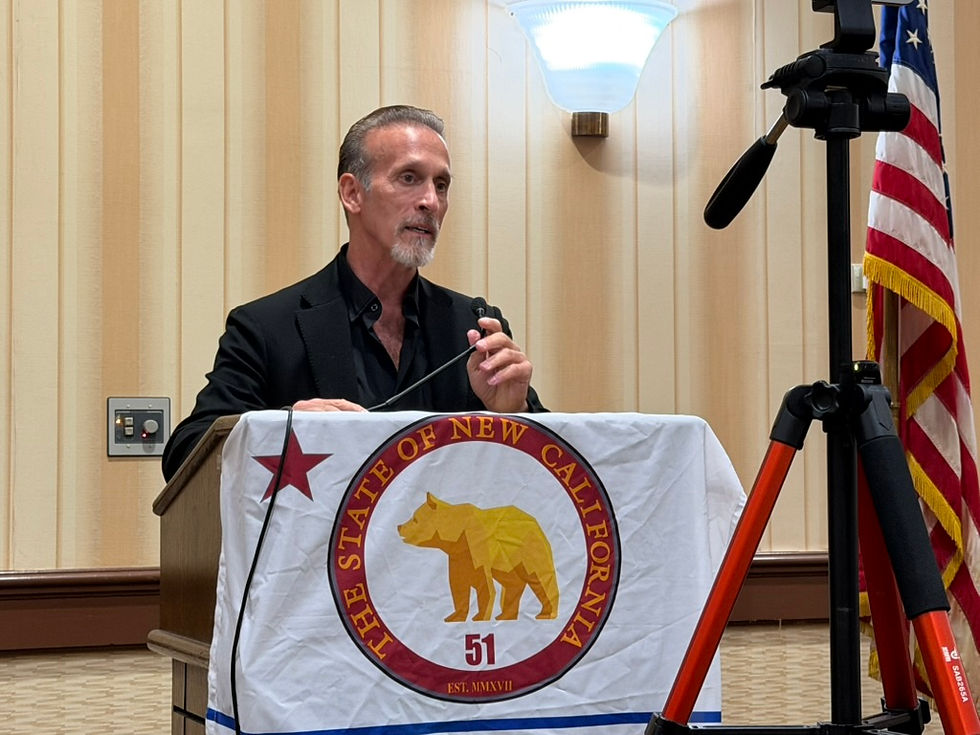
Arne List of Southern California, who has documented activity at the Shasta County Elections Office, addressed the group. He outlined plans to contact the U.S. Department of Justice regarding the 2026 handling of 2024 election materials and the shredding of records subject to retention requirements; to host a local voter-education screening of a "True the Vote"* documentary on election-material preservation within about 10 days; and to retain attorney Alexander Haberbush for potential litigation while launching a fundraising effort to cover related legal costs.
To learn more about the New California State movement, go to:
*"True the Vote" is a Houston, Texas-based 501(c)(3) nonprofit organization founded in 2009–2010 by Catherine Engelbrecht (as an offshoot of the King Street Patriots Tea Party group). Its stated mission is to promote election integrity by training citizen poll watchers, analyzing voter rolls, advocating for measures such as voter ID, and encouraging grassroots monitoring of the electoral process.