
FAA Grounds All Flights

Update:
The FAA lifted the ground stop at 5:42 pm last night. Airlines are still trying to clear traffic from the cancelled flights.
Breaking News:
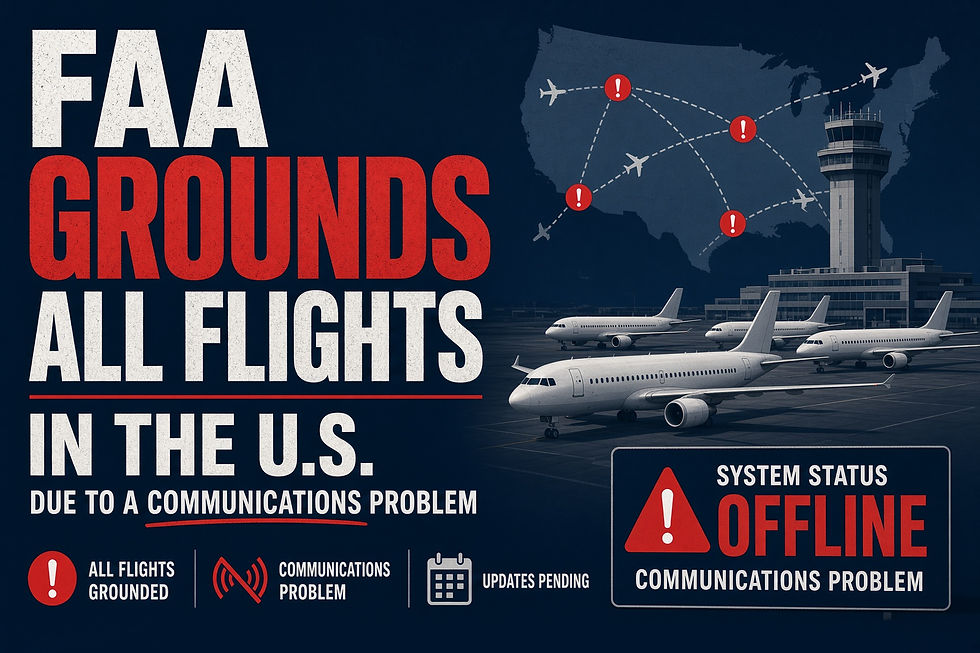
The FAA grounded the entire country this afternoon. Here's what we know, what we don't, and what it means for flights out of Redding.
A "telecommunications outage" at the air traffic control centers that guide planes between airports has stopped every departure in the U.S. DHS says there's no sign of an attack so far, but nobody has named the system that failed. At 12:54 p.m. Pacific on Friday, the Federal Aviation Administration did something it has done only twice before in this century: it stopped every departing flight at every airport in the country.
The order from the FAA's Command Center was blunt: "Due to extraordinary circumstances and for reasons of safety ... all airports are ground stopped. All departing traffic should remain ground stopped until further notice." Planes already in the air could keep going and land. Inbound international flights are being "managed on a case by case basis."
As of about 3 p.m. Pacific, the stop was still in effect, and no official had said when flights would resume. The advisory is filed through 8 p.m. Pacific tonight, but that is a placeholder, not a promise. The operative words are "until further notice."
According to the AP and CNBC, the only nationwide ground stops before today were in January 2023, when an FAA pilot-alert system failed, and after the Sept. 11, 2001, attacks.
What officials say caused it
Confirmed by officials: a communications failure at the en-route centers. At 1:16 p.m. Pacific, Transportation Secretary Sean Duffy posted that the ground stop followed "a communication issue impacting all Air Route Traffic Control Centers," the regional facilities that handle planes at cruising altitude between airports. He said FAA technicians were investigating. An FAA statement quoted by CNBC said "multiple" centers, not all. At 2:02 p.m. Pacific, the FAA posted: "There has been a temporary telecommunications outage - out of an abundance of caution all flights have been halted. Every flight has been accounted for."
The FAA's own traffic notices point the same way. According to IFR Meter, a flight-data site that tracks the Command Center's advisories, the trouble showed up regionally first.
Chicago O'Hare was stopped at 12:10 p.m. Pacific for "comms issues." Boston and Washington-area stops followed for "frequency issues." The nationwide order came at 12:54. A later Command Center advisory called it a "nationwide comms failure." None of the restrictions cited weather.
Not ruled out, but no evidence so far: a cyberattack.
Homeland Security Secretary Markwayne Mullin told reporters at the White House that there was no indication "this was a nefarious attack against us". He said, "It's just a telecommunications outage as of now," and "This isn't another 9/11." According to the Washington Post, Mullin also said the administration isn't ruling out a cyberattack but has no evidence pointing that way. The Daily Mail, citing CNN's reporting, says a law enforcement source told CNN that preliminary reports suggest the outage wasn't a cyberattack, and that FBI personnel are monitoring. Asked about a possible link to Thursday's Microsoft outage, Mullin said officials aren't ruling anything out.
Reported, not confirmed:
Radio frequencies. The Washington Examiner described a "rolling frequency outage," citing two unnamed FAA employees, and CBS News cited a law enforcement source saying radio frequencies were involved (both as summarized by IFR Meter). That's consistent with the "frequency" reasons in the FAA's own notices, but neither is an official finding.
Radar. An internal Alaska Airlines message seen by CNBC described "communications and radar issues." No official has mentioned radar.
The FAA's new traffic-management tool. According to the Daily Mail and IFR Meter, officials are looking at a new FAA traffic-management system, rolled out this week, as a possible factor. That's a question investigators are asking, not a conclusion.
The bigger backdrop. Washington's own leaders have been warning about this. ABC7 reports that Congress approved $12.5 billion last year to replace aging air traffic equipment, including old copper wiring and radios. Duffy says another $30 billion is needed. The Daily Mail reports that just one day before the grounding, Duffy formally asked Congress for $30.1 billion, writing that the money would deliver "a resilient telecommunications backbone for air traffic controllers." You don't have to be a cynic to notice the timing. Whether today's failure involved the old equipment or the new is exactly what hasn't been answered.
How big is this?
According to CNBC, flight-data firm Cirium counted 11,000 flights scheduled to leave U.S. airports after 1 p.m. Pacific. By about 2:30 p.m. Pacific, FlightAware showed more than 10,000 delays and more than 1,200 cancellations, according to figures reported by Yahoo News and compiled by IFR Meter. Both numbers were rising.
American Airlines says to expect disruption "for the rest of the day." And as CNBC points out, the longer a ground stop runs, the more crews time out on duty hours. That means the mess will likely outlast the outage itself.
The North State angle
Redding (RDD): Redding Regional's airline service is all regional jets. The City of Redding lists United nonstops to San Francisco, Denver and Los Angeles, plus Alaska to Seattle. Under the FAA's order, no departure leaves Redding until the stop lifts. That's not a matter of local discretion; it's what "all airports" means. A third-party flight board lists tonight's 6:35 p.m. United flight 4722 to SFO as canceled; confirm with United before you count on, or give up on, any seat. And because Redding's flights mostly connect through SFO and Denver, a jam at those hubs will hit Redding passengers even after departures resume.
Sacramento (SMF): Plenty of Shasta County travelers drive to SMF for the cheaper fares. It's grounded, too. The Sacramento Bee's Abridged reported 109 delayed and 13 canceled flights at SMF as of 2 p.m. KCRA reported that thousands of people were retrieving their luggage. SMF's advice: check with your airline before you head to the airport. If you're planning a three-hour drive down I-5, that goes double.
The state: Gov. Newsom's office said Cal OES is "in contact with federal and state partners to assess impacts on California airports and passengers."
What we don't know yet: whether medical flights, CAL FIRE aircraft or law enforcement aircraft operating around Redding are affected. The FAA's public notice lists no exemptions, and we haven't confirmed how they're being handled. We've reached out and will update.
The Shasta Unfiltered take
A country that can put a Starship on a launch pad the same afternoon can't keep the radios talking between its air traffic centers. Officials deserve credit for doing the safe thing: when controllers can't reliably talk to pilots, you stop putting more planes in the sky. But "temporary telecommunications outage" is a description, not an explanation. Before Congress writes a $30 billion check, Americans and the folks waiting at Redding Regional deserve to know which line, which system, which vendor, and why there wasn't a backup.


