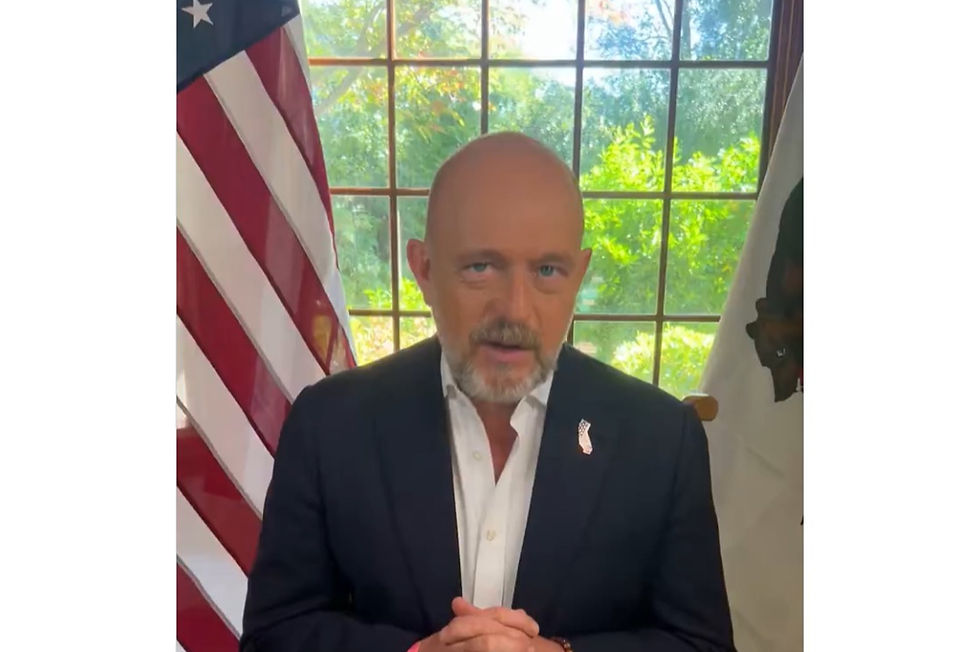
“Enough Is Enough”: Steve Hilton Outlines “CalAffordable” Vision and Path to Victory at Shasta County Lincoln-Reagan Dinner

Updated: Aug 4

REDDING, Calif. — California Republican gubernatorial nominee Steve Hilton delivered a wide-ranging keynote address at the Shasta County GOP’s Lincoln-Reagan Dinner on July 31, 2026, at the Win-River Event Center, framing the race as a fight to restore “liberty under the law,” slash the cost of living, and break what he called a corrupt one-party “machine” in Sacramento.
Speaking to a large, energetic crowd after a patriotic opening that included a Ronald Reagan video, an invocation marking America’s 250th birthday, recognition of veterans, and remarks from California Republican Party Chairwoman Corinne Rankin, Hilton opened by contrasting the live audience with his campaign video that used AI to depict a Democratic “machine” selecting opponent Xavier Becerra. “What’s better? Real life or the AI?” he asked, drawing cheers for the crowd’s answer of “Real life!”
Hilton, a British-born former Fox News host and adviser to UK Prime Minister David Cameron who became a U.S. citizen in 2021, emphasized his identity as an outsider and the son of Hungarian immigrants who fled communism. He recalled attending a small dinner for Margaret Thatcher’s 80th birthday at which the ailing former prime minister unexpectedly rose and closed her remarks by invoking the partnership with Reagan around “liberty under the law.” That principle, Hilton said, should define California again and would be “the best 250th birthday present we could possibly give” the nation. He described the election as California’s chance to “rejoin America.”
He repeatedly returned to cost of living as the central issue. California, he said, ranks 50th out of 50 for opportunity according to U.S. News & World Report, burdened by the highest costs, poverty rates, and layers of regulation after 16 years of one-party rule. Hilton announced that, if elected, veterans would pay neither state income tax nor property tax. His broader “CalAffordable” platform centers on $3-per-gallon gasoline, cutting utility bills in half, making the first $150,000 of income tax-free, and expanding starter homes so young families can remain in the state instead of leaving.
Hilton argued he could deliver rapid change through executive authority even without a Republican legislature. He pledged to replace ideologues on boards and commissions with practical appointees, direct more water to farmers by revising biological assessments at the State Water Resources Control Board, increase California oil production and refining by ordering CalGEM to issue permits proactively, reactivate underused natural-gas and hydroelectric capacity, properly manage forests for timber and housing materials, and rein in energy regulators he said employ 35 times more bureaucrats per capita than any other state.
He reserved his sharpest criticism for Becerra, calling him a 36-year career politician and “puppet of the machine” who has accepted none of six offered televised debates. Hilton highlighted controversies from Becerra’s time as Health and Human Services secretary, a federal guilty plea by a former chief of staff involving campaign funds, and taxpayer-funded nonprofits such as CHIRLA that he said engage in ballot harvesting, including by non-citizens. He also attacked Proposition 50 redistricting and efforts to alter voter-ID ballot language, vowing to fight for fairer representation. “The more they spend, the worse it seems to get,” he said of state government, promising aggressive vetoes and the power to defund programs and commissions that do not make life more affordable, easier, or safer for California families and businesses.
On the electoral path, Hilton cited internal polling showing him at 33 percent solid support, Becerra at 41 percent, and 26 percent persuadable—disproportionately working-class and Latino-leaning voters focused on affordability and concentrated in Southern California. He estimated six million votes would be needed and noted that President Trump received 6.1 million in California in 2024 without heavy campaigning. “If you get one other person who wasn’t going to vote and make them vote Republican, you’ve just doubled the vote,” he told the audience, stressing grassroots turnout over any institutional “machine.”
In an extended question-and-answer session, Hilton addressed local and statewide concerns. On forest products and biomass, he promised to overhaul the Public Utilities Commission and related agencies. On education, he said he would curb bureaucratic overreach beyond legislative intent and replace State Board of Education members focused on ethnic studies with parents and common-sense voices. At the same time, public schools struggle with basic literacy and math. Farmers heard commitments on water, energy costs, overtime rules, and pesticides through executive orders and appointments. He discussed attracting oil production back to California, easing insurance costs by increasing competition and limiting litigation, and consulting Central Valley counties on any salvageable high-speed-rail infrastructure after halting further payments on day one. He affirmed that reaching Latino voters—who make up about 40 percent of the population—through launches in places such as Boyle Heights and a message of opportunity is central to the campaign.
Hilton closed by rejecting the notion that California is permanently Democratic as “a very un-American attitude,” invoking Reagan’s determination in winning the Cold War and Charlie Kirk’s early campus organizing that began with just two people in attendance. “I see a California where we put ourselves back on the path of common sense and sanity and restore the California dream,” he said. “Enough is enough. We are going to go out there and fix California.”
In that spirit of resolve, Hilton left the room with a clear charge: the future of the Golden State is not predetermined by party registration or past election results. It rests in the hands of ordinary Californians willing to show up, speak up, and work for a state that once again rewards hard work, protects freedom, and offers genuine opportunity to the next generation. With the tools of executive leadership, a focused message of affordability, and the energy visible that night in Shasta County, he argued, the California dream can be restored—not as nostalgia, but as a living reality for families across every region of the state.