
Council Member Candidates Present Their Visions for the City at Redding Chamber of Commerce-Hosted Forum on September 16th, 2026


The Greater Redding Chamber of Commerce’s Redding City Council candidates forum on Wednesday, Sept. 16, 2026, was held at the Cascade Theatre, 1731 Market Street, Redding, from 5:30 to 7 p.m.
Host/emcee: Todd Jones, president and CEO of the Greater Redding Chamber of Commerce. He opened the program and ran the forum. The Chamber’s posted recording also credits the event to the Chamber’s Government Affairs Committee.
Who are the Candidates? (nine people for three at-large seats on the Nov. 3, 2026, ballot)

Tenessa Audette, 47, is a first-term incumbent elected in November 2022 and a former Redding mayor (peers chose her in December 2023). Born in North Hollywood, she is a wife and mother of three. She holds a B.A. in political science from Sonoma State University and interned for then-State Sen. Wes Chesbro. She later worked as a district representative in the California State Senate, founded Called to Action Consulting, managed campaigns, and was the 2024 Republican nominee for Assembly District 1 (she lost to Heather Hadwick). She has taught a “God and Government” class at Bethel School of Supernatural Ministry and sits on multiple regional boards, including the California Council of Governments and LAFCO. At the forum she called herself the council’s fiscal “watchdog.”

Elise Ramirez Sloan is a relative newcomer to Redding who grew up in Placerville and has lived in the Bay Area, Orange County, Eureka, and Pittsburgh. She told the Record Searchlight she is running as a resident, not as part of a business slate, and that most people cannot give the hours that council work demands. Her work has been in restaurants, wineries/agriculture, and public education; as a high school secretary she learned California’s account-code budget system and how to write and manage grants. At the Cascade she said she can “read a budget, write a budget, write a grant, and maintain a grant.” She criticized the council for approving a no-bid outside auditor for review of the budget and financial report prepared by City Finance Director Greg Robinett. In her newspaper interview, she opposed data centers and more Flock-style cameras.

Jack Munns, about 68, is a first-term incumbent elected in 2022. Born and raised in Redding, he graduated from Enterprise High School and started at Shasta College before moving to Reno in 1981 to work in casinos. He joined the Reno Police Department in 1989, spent 21 years there, and retired as a sergeant on June 17, 2010; he moved home two days later. While on the force, he earned a bachelor’s in criminal justice and a master’s in social work and built Kids Korner, a grant-funded child-abuse and neglect program that won two national awards. He also founded the Jacali nonprofit and has made 12 medical-and-orphanage trips to Kenya. He is a former Shasta County grand juror. He and his wife, Vanessa, have two sons, Josh and Justin. He coaches youth sports and is active in local churches.

Christina Prosperi is a third-generation Redding native, born at Mercy Hospital, married to another local, and raising three children. She spent 10 years as an MRI technologist, stayed home with her kids, then went into public service at Caltrans District 2, rising to senior transportation planner and branch chief for the Complete Streets division. She has served as president of the Redding Parks and Trails Foundation and on SRTA’s Social Services Transportation Advisory Council. She and her husband own TRUE Ride, the indoor cycling studio a block down Market Street from the Cascade. KRCR reported she wants to “hit the ground running” given vacancies in the city manager, police chief, fire chief, and finance director jobs.
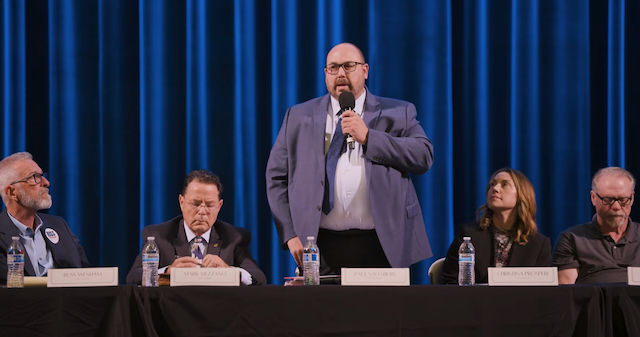
Paul Saulsbury was born in Kennewick, Washington, grew up in Alaska (first 22 years, he told the forum), and now works in Redding as a mobile crisis clinician / associate marriage and family therapist. He is a former EMT in Alaska and Washington, former group-home counselor, former flight attendant, and small-business owner. He graduated from Palmer High School, earned a B.A. from Cal State Chico in 2016 (communication studies / public affairs), and a graduate degree from Simpson University in 2024. He is a father. He ran as a Republican in the June 2026 primary for Congress in CA-02 and lost; he is now running for council. His city-council site lists an endorsement from UA Local 228. Saulsbury said Klemmer Academy (a leadership workshop) taught him to look for outcomes in which both sides gain, and he offered that as his model for council work.

Mark Mezzano, 70, was born in Chicago in August 1956, the oldest of seven. He attended Northeastern Illinois University, lifeguarded on Lake Michigan, then flew for United Airlines before joining the California Highway Patrol in January 1983. He retired as a sergeant in 2011 after about 28–29 years. Assignments included auto-theft detective work, school-bus and ambulance inspection, child-seat programs, and field public affairs in Sacramento. He moved his family to Mt. Shasta in 1999 and to Redding in 2005. Elected to the council in 2020 as the top vote-getter, he served through 2024, including as mayor pro tem / vice mayor, and now works as an Assembly District 1 field representative for Assemblywoman Heather Hadwick. He and his wife, Kathy, a retired OR nurse, have two adult children. He chairs the Shasta Regional Transportation Agency. On his record of accomplishments, he cites more sworn police officers, three firefighters per engine, and land for a ninth fire station.

Russ Wenham is a Redding native and fifth-generation far-northern Californian. He is a 42-year civil engineer. The first half of his career was at Caltrans in Sacramento and Redding, including as deputy district director, managing programs and hundreds of employees with a budget he says was on the order of half the city’s. The second half was consulting, most recently as a project director at GHD; he left that job this summer to campaign. He has worked on more than 100 Redding-area projects, chaired the Planning Commission (about two years on the commission), sat on the city’s development-impact-fee update committee, served on the Shasta County Grand Jury, put in 32 years in Rotary, and did volunteer construction management at Enterprise Community Park and pro bono work for veterans’ facilities.

Joana Rebollar grew up in this community. She is founder and owner of Veritas Tax and Financial Solutions, president of Northern Business Associates, and a co-host on Radio Mexicana. She told the Record Searchlight she works with businesses and households on bookkeeping, taxes, payroll, financial reporting, and compliance — the same stack of decisions she said council members make with public money. At the forum, she said nine years in that work taught her that “numbers have a pattern,” and that she is self-funded and independent of special-interest money.

Rebecca Anne Miller grew up in the Pajaro / Salinas Valley around Watsonville, a farm town in Santa Cruz County. Her parents were ministers; her father started what is now Teen Challenge of Monterey Bay. She moved to Redding about two years ago because it “felt like home,” and is raising two teenage children here. She has about 20 years in health care and works as a substitute teacher. At an SCRA forum, she identified as a Republican, backed a parental-rights resolution, voter ID, and cutting executive pay if the efficiency study supports it. On the Chamber stage, she said she is “not a politician” and is running as “the voice of the people.” She files as Rebecca Anne Miller because “there are so many Millers.”
The candidates each had 60 seconds to answer questions prepared by the chamber, each answering the same question.
City manager: appoint Michael Webb, or recruit?
Jones asked how the city should fill the permanent city-manager job and several vacant department heads after William Tarbox’s death.
Mezzano named Webb. He said department heads will not take jobs until they know their boss, that an outside consultant search would leave Redding without a manager “until June,” and that Webb — a former Caltrans hire as public works director — “deserves a shot.” “He’s very intelligent. He’s very young. He’s going to be here for a while.”
Munns named Webb. Council hires only the manager and the city attorney, he said. Webb was assistant manager about four months under Tarbox and has been in the chair about two and a half months. “Putting him in the city manager job permanently would bring some calm and peace and tranquility to the city,” if Webb already has a plan to get the city “back to about 80 percent in a couple, three years.”
Saulsbury named Webb. “Michael Webb is fully capable of doing that position and I think he should be moved into that permanent position as soon as possible.” He said Webb is already covering four departments and declined a fifth the night before because he was overloaded. Other hires, Saulsbury said, belong to the manager, not the council.
Miller said “the position needs to be filled,” that the person already “in the room” seems knowledgeable, and that Redding should “hire someone from within our city.” She did not use Webb’s name. She did call for cutting the pay attached to the job (see below).
Audette did not back an immediate appointment for Webb. She said the city should have been recruiting two weeks after Tarbox's death. The deficit was reported in May as $2 million to $3 million but is now “about $7 to $8 million,” she said, so the city needs someone with deep finance and city-management experience. “The timeline is 12 weeks. We will have somebody in by December if we get this started now.”
Wenham also pushed a search, not a named appointment. He said recruitment should have started “the week after Mr. Tarbox passed,” called months of delay “paralysis,” and said acting leaders should keep filling department-head jobs instead of freezing the org chart.
Rebollar said the city needs a manager but also “financial transparency” and “so many missing pieces” before more spending decisions. If Redding hires a manager, “we should probably pay them well so they do a good job.”
Sloan asked why the other jobs are vacant, then said recruit outside and promote “key staff here that know the ins and outs.”
Prosperi refused to pick a name in 60 seconds. She said she has been both the acting hire and the hiring manager, sees “risk and reward on both” sides, and wants the council to “come to a consensus” and act. She ran out of time: “I support hiring. I can’t even finish it. I can’t even say it. It’s too up in the air.”
(On Sept. 21, five days after the forum, the sitting council voted to hire a recruiting firm rather than appoint Webb that night.)
Circle 6: who said use the study?
Several candidates treated the Circle 6 efficiency study as a to-do list, not a suggestion file.
Saulsbury, on roads: pavement condition is “essentially at 49” and needs to reach “about 70,” which he priced at about $15 million against roughly $7.5 million in current road funding. “How we’re going to be able to do that is essentially utilize the things that Circle 6 has talked about, expand that tax base, become efficient, find out where we can save money, and allocate specific money for funding for our roads.”
Saulsbury, on cuts: protect public safety first, then “look from the top down.” “We have a lot of overtime with police and fire, and we have administrative costs that are pretty high that we need to look at, and I’d be utilizing Circle 6 efficiency study for that.”
Audette: “What Circle 6 confirmed was that we grew many layers in our administration. And so we have a lot of bloat at the top.” She said voters want front-line police, fire, and counter staff protected while the extra layers are cut.
Munns: “When you take down a fence you really want to know why that fence was put up.” Circle 6, he said, mapped which fences can come down. “The biggest part would be middle management… eliminating some of those positions won’t be as critical as others.”
Mezzano, in his close: if elected, he would “follow the Circle Six advice, create finding ways where we can cut costs, save money, eliminate duplication of services, overlap.”
No candidate at the microphone defended leaving the study on the shelf. None of them, in the 60-second answers captured on the Chamber recording, volunteered support for Circle 6’s data-center trial balloon; however, Audette stated she would rather have data centers than a new casino. The data center idea had already drawn public and council pushback at the Sept. 15 council meeting.
Who would cut high-end City Hall pay?
Miller was the most specific on the city manager’s paycheck. She said published figures she had seen put the job near “$400,000, which is more than the president makes, and that just seems a little absurd for little Redding.” Cutting that pay, she said, would also help the budget.
Audette aimed at the org chart above the front line: “bloat at the top.”
Prosperi named middle management as the Circle 6 target, not firefighters or police on the street.
Saulsbury named administrative costs and overtime, using Circle 6 as the screen, while saying public safety is not the first place he would cut.
Mezzano did not put a dollar figure on the manager’s salary at the forum. In his August Record Searchlight interview he had already floated salary caps and asking unions about a monthly unpaid day. On stage, he refused to cut public safety and pointed instead at park promises and other spending.
Rebollar went the other way on the manager’s wage: pay a qualified manager well, but freeze big new spending until the books are clear.
Economy: one best shot, not a slogan
Jones asked for the single best growth move and what the city should do first.
Audette — Opportunity Zones. Put the right parcels in Opportunity Zones so business costs drop, jobs follow, then housing and retail. She called that the flywheel.
Sloan — health care. Use the new oncology center as proof Redding can land more care. She named possible partners: UC Davis, Stanford, and local training so nurses and doctors “put their dollars back with the community” and stay.
Miller — health care, same lane, different detail. Twenty years in the field. She said she was referred to Davis and never seen, and her mother was sent to Mountain Gate and Red Bluff. Dignity Health’s cancer center, she said, means “hundreds of jobs.” Keep care in Redding “no matter what your insurance is.”
Prosperi — build and export from land the city already owns. Prioritized Oasis and Stillwater development and manufacturing, emphasizing export capabilities with the airport and rail so businesses build it here and ship it out. Partner with the EDC, scale a local startup, treat Amazon as a signal that firms will locate here.
Saulsbury — grow the tax base, not the tax rate. Infill houses on already-served lots. He said more than half the Stillwater parcels are in play and cited $7.9 million from the economic development center to expand the park. “Once we start building, that’s when our tax revenue is going to come in.”
Munns — temporarily lower impact fees. Housing costs are “extraordinarily high.” He floated smaller homes, but said safety and infrastructure come first, then “drop the cost… fees, incentives to bring businesses in.”
Mezzano — high-pay careers, measured by ROI. “You need to talk about good-paying jobs, jobs that lead to careers,” so families buy houses and pay taxes. Score projects by return on investment.
Wenham — write it into City Hall’s job descriptions. Memorialize a rule at City Hall: every mission statement and every staff decision should answer whether Redding is “the best place to do business… in far northern California.” We have an epidemic of drug use, so we need to prioritize front-line cops.
Rebollar — fund what pays for itself. “Numbers have a pattern.” Back programs and businesses that cover their costs, invest in firms already here, and do not raise the cost of living if the goal is to keep people.
How the rest of the night broke
On impact fees, Sloan said she would not cut or raise them until she saw which projects the fees are actually blocking. Wenham, from his impact fee committee work, wanted fees matched to real system costs and would shift or redistribute the sewer/water fees to fund road impacts since the City's sewer and water systems are fine but the roads are "horrific". Audette said she is working on the committee reviewing the impact fees and going through that study. She said she is reviewing the impact-fee formula and doesn't want to penalize businesses that are doing well and scaling up by charging them exorbitant impact fees.
On whether homelessness is the responsibility of the city or the county, Wenham drew a hard line: the city does law enforcement, fire, and grant pass-throughs; county does “everything else.” Audette and Munns both pointed to the city’s loan that helped Good News Rescue Mission build a day resource center. Munns said Jonathan Anderson’s mission has put “over 13,000 people back in permanent housing over the last 10 years.” Miller cited a Santa Ana “jail or program” model. Sloan wanted the city website to list help before someone loses power. Prosperi wanted the old “at home” partnership matrix back with Anderson and the county. Saulsbury warned the audience about Proposition 44 on the statewide ballot.
Jones said written answers were 20 percent of the Chamber score, private interviews 50 percent, and this forum 30 percent. The Chamber recording is on its YouTube page. The election is Nov. 3. As of this date, the Chamber has not announced how it has rated the candidates.
Shasta Unfiltered commends all nine candidates for stepping forward. A Redding City Council seat is unpaid in any real sense of the word — $600 a month, a figure last set in 1993 — and the work runs far beyond two evening meetings per month. Packets, constituent calls, committees, and budgets will eat up their nights and weekends. These candidates put their names on the ballot anyway. That choice, more than any one answer at the Cascade, is worth noting.
To watch the entire video, go to:


