California's Descent into Tyranny: When Government Turns Against Its People

Opinion
The California government, once a beacon of opportunity and innovation, has crossed a perilous threshold. What began as progressive governance has evolved into something more insidious: a system of entrenched, unaccountable power that disrespects constitutional limits, overrides the will of the people, and imposes arbitrary rule at great human and economic cost. This is not mere inefficiency or policy disagreement. It represents a turn toward tyranny—majoritarian in form but despotic in effect—in which a dominant political faction exercises power without meaningful restraint, eroding the consent of the governed.
The Erosion of Constitutional Foundations
California's 1879 Constitution, which superseded the 1849 original, was designed, in theory, to add safeguards against legislative excess, including separation of powers and direct democracy. Yet today, this constitution, amended over 500 times, has descended into pure majority rule, and the legislature, governor, and allied courts often treat these checks as mere nuisances.
When the California government sees something that its citizens want that it doesn't like, it suddenly passes a law banning that very thing. As evidence, we offer the following examples. Governor Gavin Newsom signed SB 1174, prohibiting local voter ID requirements. AB 969 restricted the hand counting of ballots. In May 2026, SB 73 criminalized sheriffs' ability to seize ballots for investigation.


Sheriff Chad Bianco Siezes Ballots
Sanctuary Policies: Defiance of Federal Law
California’s sanctuary policies — enacted at the state, county, and city levels through measures like the California Values Act (SB 54) — represent a direct challenge to federal authority under the Supremacy Clause of the U.S. Constitution. These policies prohibit local law enforcement from cooperating with federal immigration enforcement, including honoring ICE detainers for removable criminal aliens.

Critics argue these policies go further and violate federal criminal law by effectively harboring illegal aliens. Specifically, 8 U.S.C. § 1324(a)(1)(A)(iii) makes it a felony for any person who, “knowing or in reckless disregard of the fact that an alien has come to, entered, or remains in the United States in violation of law, conceals, harbors, or shields from detection, or attempts to conceal, harbor, or shield from detection, such alien in any place, including any building or any means of transportation.” By systematically shielding unlawfully present aliens from federal detection and removal — including those with serious criminal records — California’s sanctuary framework crosses into prohibited territory under this statute.
Policy Failures as Evidence of Arbitrary Power
Tyranny reveals itself in the chasm between unchecked authority and disastrous results. Crushing taxes at every level—property, income, sales, gas, and countless fees—have made California one of the most expensive states to live and do business in. These burdens, paired with heavy regulations, have driven businesses, jobs, and residents out of the state in droves, while making everyday life increasingly difficult for average Californians struggling with housing, fuel, and groceries.
Compounding the fiscal extraction is wanton corruption that has infected major government programs. Billions vanish into fraud and waste across Medi-Cal, hospice services, autism/early intervention programs, and EDD unemployment systems. Explosive growth in fraudulent billing, hospice schemes, and pandemic-era fraud exposed systemic vulnerabilities and lax oversight.
Nowhere is this dysfunction more visible than in the homelessness industrial complex. Despite spending over $24 billion in recent years, homelessness continues to grow, with California leading the nation in unhoused individuals. A sprawling network of NGOs, contractors, and consultants receives massive funding streams while the problem worsens. There is simply too much money in the system—salaries, overhead, consulting fees, and perpetual program renewals—for actual solutions to be in anyone's interest. The incentives reward expanding the bureaucracy and managing the crisis, not ending it. Visible decay proliferates while billions flow and more encampments appear.

California's homelessness crisis — billions spent, yet encampments expand.
Where does it end? When government extracts relentlessly, delivers poorly, shields itself from accountability, and profits from perpetual failure, legitimacy collapses.
The Nature of This Tyranny
One-party dominance has produced soft tyranny through election controls, immigration nullification, taxation without results, entrenched corruption, and a self-perpetuating homelessness industry. Consent of the governed has become illusory.
Withdrawing Consent: The Time for Lawful Action Is Now
The government exists only at the consent of the citizens. When it turns tyrannical, citizens have an obligation to withdraw that consent through constitutional means. The time for action is now.
Lawful avenues include:
Ballot initiatives to restore voter ID, hand counting transparency, spending limits, and repeal sanctuary laws.
Recalls of unresponsive officials.
Legal challenges asserting federal preemption.
Local and electoral organizing to elect reform-minded leaders.
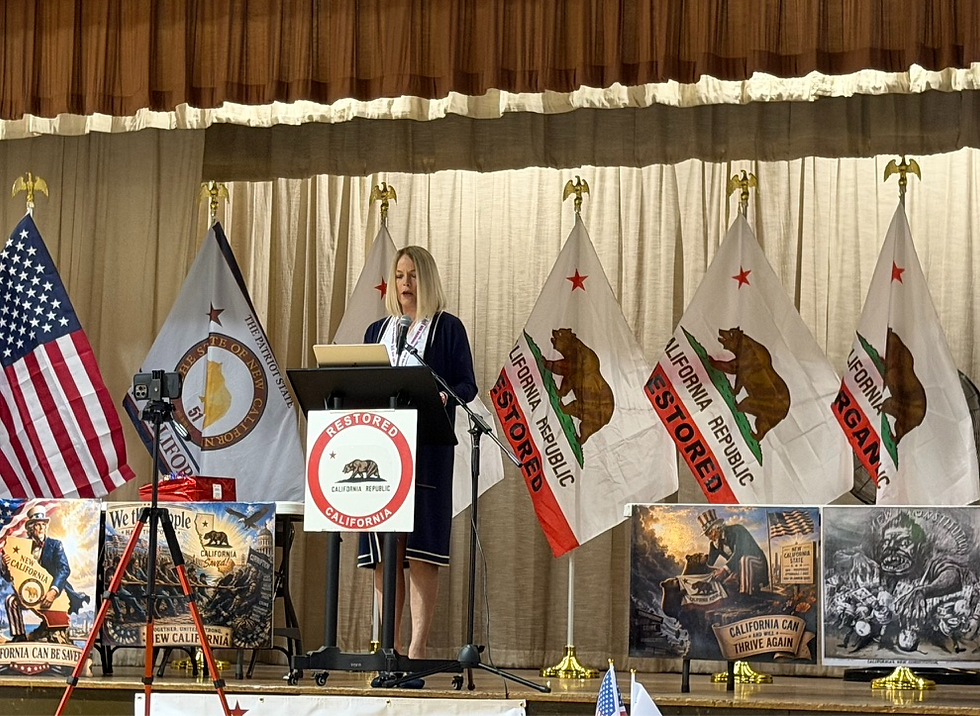
State partition initiatives represent a bolder but fully constitutional remedy. Drawing on Article IV, Section 3 of the U.S. Constitution (which permits new states from existing ones with legislative and congressional consent). There are 2 significant movements underway in California.
The New California initiative seeks to divide the state into 2 parts as shown in the map below. New California is shown in red and what is left behind as California is an odd "island" state comprised of the Greater Los Angeles, Bay Area and Sacramento areas all surrounded by New California. Many critics believe this will not be viable.

The James Gallagher 2 state split proposed by Assemblyman James Gallagher largely separates the state between inland/rural counties from coastal/urban ones. This would allow regions with fundamentally different values and governance priorities to form. All the counties within each respective state are contiguous.

Key Differences: The two initiatives differ in approach. New California is grass roots led. The effort is being spearheaded by radio commentator Paul Preston. They have held multiple conventions with open invitation to the public to attend. They are seeking to split the state using the West Virginia model.
The Gallagher initiative is focused at the governing bodies of interested counties. Indications are that as many as 11 contiguous counties have either already passed County resolutions supporting the Gallagher resolution or are in the process of doing so. The counties that have passed resolutions are: Shasta, Lassen, Modoc, Yuba, Sutter, Glenn and Colusa. Counties that are considering are: Plumas, Nevada, Tehama, and Butte. Since the passage of Proposition 50 that hijacked the legal process for drawing district boundaries, the list of counties that support the Gallagher initiative may be growing.
Splitting the state, while challenging and requiring broad consensus plus federal approval, such do have historical precedent (e.g., West Virginia) and offer a peaceful, democratic path to restore self-government where reform within the current structure proves impossible. Supporting qualified initiatives, county resolutions, and public advocacy for partition deserves serious consideration as a legitimate exercise of popular sovereignty.
California has turned the corner toward tyranny. The people must act decisively—through elections, initiatives, recalls, courts, and structural reform like state division—to reclaim their sovereignty. Lawful, determined action is the duty of a free people. The time is now.