
Artemis II Triumph: NASA’s Crew Returns from Historic Moon Flyby as America Accelerates Push for Lunar Dominance in Face-Off with China
- Rex Ballard

- Apr 11
- 5 min read

rochesterfirst.com The Artemis II Crew (left to right): Commander Reid Wiseman, Pilot Victor Glover, Mission Specialist Christina Koch, and CSA astronaut Jeremy Hansen. Their flawless performance proved humans can thrive on the road to the Moon.
In a blaze of American engineering and unapologetic ambition, NASA’s Artemis II mission splashed down safely in the Pacific Ocean off San Diego on April 10, 2026, capping a flawless 10-day journey that marked humanity’s first crewed voyage beyond low-Earth orbit in more than half a century. The four astronauts—Commander Reid Wiseman, Pilot Victor Glover, Mission Specialist Christina Koch, and Canadian Space Agency’s Jeremy Hansen—touched down at approximately 8:07 p.m. EDT (5:07 p.m. PDT) aboard the Orion spacecraft they christened Integrity. Recovery teams aboard the USS John P. Murtha pulled the capsule from the waves, confirming all four crew members were healthy and elated after traveling farther from Earth than any humans in history.
This wasn’t just a test flight. It was the opening salvo in America’s renewed commitment to the Moon—and a direct answer to Beijing’s accelerating plans for the lunar South Pole.
Launch: April 1, 2026 – Back to the Moon on American Muscle
Watch the launch of Artemis II
The mission kicked off at 6:35 p.m. EDT on April 1 from Launch Complex 39B at NASA’s Kennedy Space Center in Florida—the same pad that once sent Apollo astronauts skyward. NASA’s massive Space Launch System (SLS) rocket, the most powerful ever built, thundered to life, propelling Orion and its international crew into orbit. Within minutes, the solid rocket boosters separated, followed by the core stage, setting the stage for a free-return trajectory around the Moon.

Early mission highlights included multiple orbital adjustment burns, including a critical perigee raise and the translunar injection (TLI) burn that flung Integrity toward the Moon. The crew conducted systems checks, manual piloting demonstrations, and life-support validation, proving that Orion could sustain humans in deep space for the long haul.
The Lunar Flyby: April 6 – Far Side Views and Record-Breaking Distance
Watch the official lunar flyby broadcast and crew commentary:
The mission’s dramatic peak came on Flight Day 6. As Orion swung around the Moon, the crew achieved a closest approach of roughly 4,067 miles (6,545 km) above the lunar surface. For about seven hours, they studied the Moon up close, capturing stunning imagery of the far side—terrain no human eyes had seen in such detail since Apollo. Communications blacked out for roughly 40 minutes as the spacecraft passed behind the Moon, a tense but planned period of radio silence.
During the flyby, the astronauts broke Apollo 13’s 1970 distance record, reaching approximately 252,756 miles from Earth. They proposed naming two previously unmapped craters “Integrity” (after their spacecraft) and “Carroll” (in memory of Wiseman’s late wife). Earthrise photos and high-resolution far-side imagery poured back to Mission Control, delivering both scientific gold and visceral proof that America is back in the lunar game.


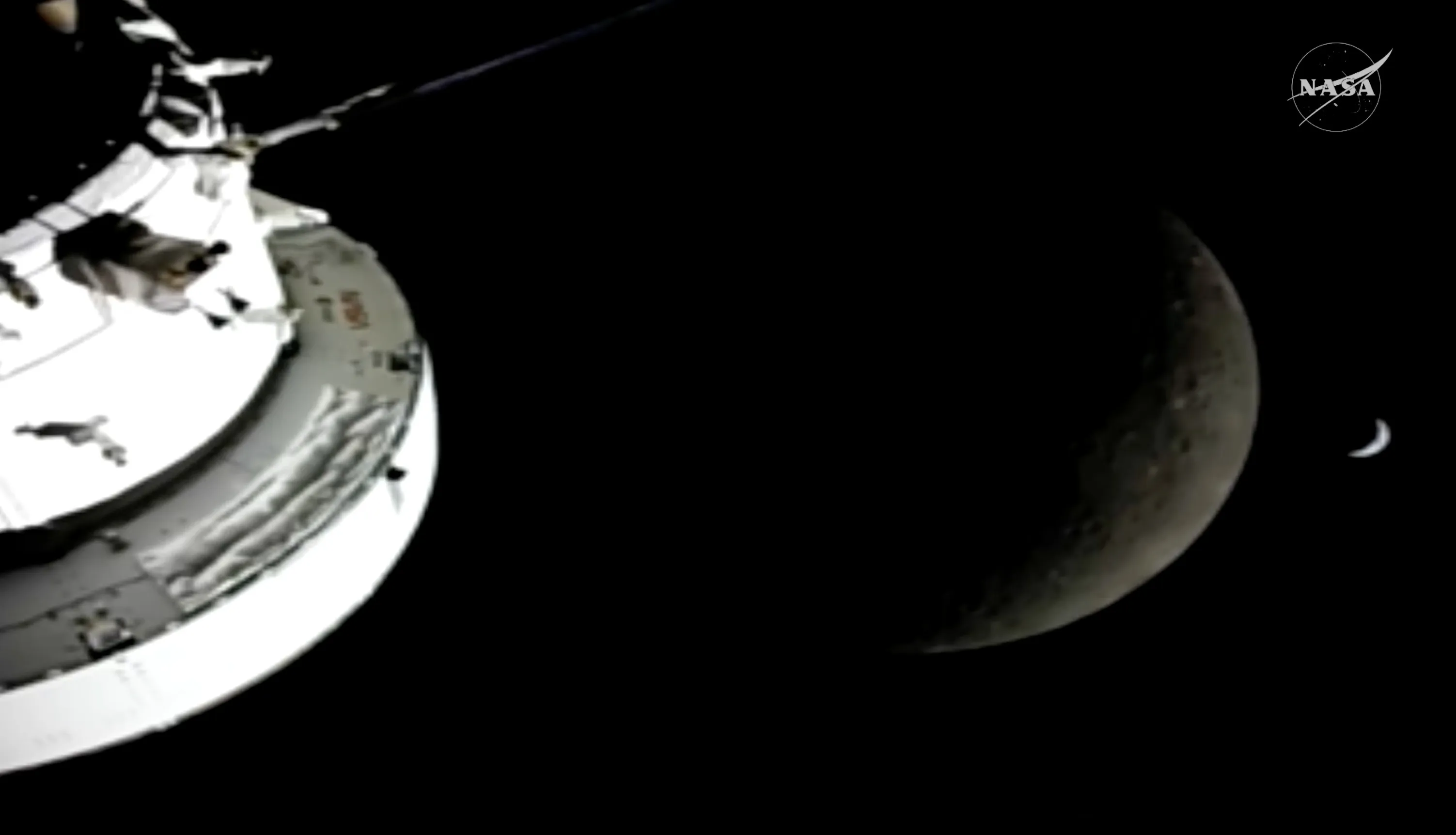


The crew performed additional science observations, Earth-Moon imaging, and systems tests while under the Moon’s gravitational influence, before the lunar sphere of influence exit put them firmly on the homeward path.
Return and Splashdown: April 10 – Precision Re-Entry at Mach 33
Watch the full re-entry, parachute deployment, and splashdown
After a smooth trans-Earth coast, the crew prepared for the fiery finale. On April 10, Integrity jettisoned its service module, oriented for re-entry, and slammed into Earth’s atmosphere at nearly 25,000 mph—experiencing temperatures around 5,000°F. Parachutes deployed flawlessly; the capsule hit the Pacific right on target. Within hours, the astronauts were aboard the recovery ship, enjoying the fresh air and grinning for the cameras. Post-splashdown briefings confirmed every major objective met.

Splash Down image - i0.wp.com
Why This Mission Matters: The Road to the South Pole and Artemis IV
Artemis II wasn’t about planting flags—it was about proving the hardware, operations, and human factors for sustainable lunar exploration. By validating Orion’s heat shield, life support, navigation, and deep-space performance with a crew aboard, NASA has cleared the path for Artemis III (mid-2027 low-Earth orbit lander rendezvous tests) and Artemis IV (early 2028), the first crewed lunar landing since Apollo 17.

Artemis IV - Wikipedia
Watch the latest NASA/SpaceX Artemis IV & Starship HLS readiness overview: Will Starship HLS Be Ready for Artemis IV?
Artemis IV: First Crewed South Pole Landing Powered by SpaceX Starship HLS
For Artemis IV, the four-person crew will launch aboard SLS/Orion to lunar orbit (likely rendezvousing with the Lunar Gateway station). Once there, they will transfer to SpaceX’s Starship Human Landing System (HLS)—the enhanced “Option B” sustainable variant NASA contracted specifically for this mission. Two astronauts will descend in the massive Starship lander to the lunar South Pole for roughly one week of moonwalks, science, and sample collection, then ascend back to lunar orbit to rejoin Orion for the return to Earth.

Artist rendering of SpaceX Starship landing on the moon - image - nasa.gov
Starship HLS is roughly 165 feet tall—about the height of a 15-story building—and features an elevator for crew and cargo transfer to the surface. This partnership is deliberate: NASA leverages SpaceX’s rapid iteration and reusability while Orion/SLS handles the crew transport leg. Starship HLS will also support future missions with greater payload capacity and longer surface stays, directly enabling the utilization of water-ice resources that turn the Moon into a launchpad.
The ultimate destination? The lunar South Pole. Permanently shadowed craters are believed to hold billions of tons of water ice—a game-changing resource that can be split into oxygen for breathing and hydrogen/oxygen for rocket propellant. That means fuel depots, life support, and in-situ resource utilization (ISRU) that turn the Moon into a launchpad rather than a one-way destination. Future bases at the South Pole will enable long-duration stays, scientific outposts, and eventual expansion to Mars.

Believed water ice locations on the moon - image scientificamerican.com
The Strategic Reality: America vs. the CCP in the New Space Race
This isn’t nostalgia for Apollo. It’s a cold, hard strategy. China’s space program is moving fast. Beijing has openly targeted a crewed lunar landing by 2030 and is building the International Lunar Research Station (ILRS) in partnership with Russia—explicitly focused on the South Pole. Their Chang’e-7 and Chang’e-8 robotic missions are currently scouting resources. Water ice isn’t just science; it’s strategic leverage. Control the ice, control the fuel supply for cislunar operations. First-mover advantage lets the winner set the rules, establish infrastructure, and potentially deny rivals access.
The U.S. has responded with the Artemis Accords—principles for peaceful, transparent exploration signed by dozens of nations. Artemis II’s success—and the confirmed timeline to Artemis IV with SpaceX—sharpens that edge. Every milestone puts American hardware, standards, and partnerships ahead. Delays are no longer an option; the CCP is watching the calendar.
Many scientists believe that space isn’t just about pretty pictures—it’s about resources, security, and national power in the 21st century. Artemis II delivered. The crew proved the ship works. Now the real race begins: boots on the South Pole, permanent bases, and lunar industrialization before Beijing plants its flag and starts drilling.
The Moon is no longer a destination. It’s the high ground of the future. America just reclaimed the lead—with SpaceX as a key partner. The question is whether Washington will keep the foot on the gas—or let the CCP lap us again.


